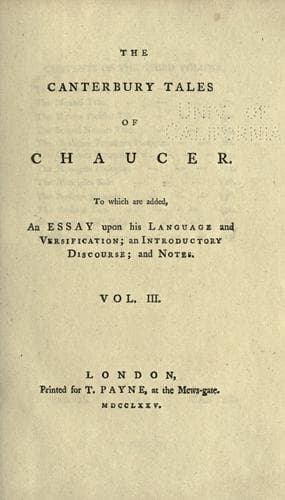
The Canterbury Tales, and Other PoemsChaucer, Geoffrey
ReligionChristian
The Canterbury Tales, and Other Poems
Chaucer, Geoffrey
Chaucer, Geoffrey, -1400; Christian pilgrims and pilgrimages -- Poetry; English poetry -- Middle English, 1100-1500
Before a word beginning with a vowel, or with the letter “h,”
the final “e” was almost without exception mute; and in such
cases, in the plural forms and infinitives of verbs, the terminal
“n” is generally retained for the sake of euphony. No reader
who is acquainted with the French language will find it hard to
fall into Chaucer’s accentuation; while, for such as are not, a
simple perusal of the text according to the rules of modern
verse, should remove every difficulty.
Notes to Life of Geoffrey Chaucer
1. “Edmund Spenser, a native of London, was born with a Muse
of such power, that he was superior to all English poets of
preceding ages, not excepting his fellow-citizen Chaucer.”
2. See introduction to “The Legend of Good Women”.
3. Called in the editions before 1597 “The Dream of Chaucer”.
The poem, which is not included in the present edition, does
indeed, like many of Chaucer’s smaller works, tell the story of a
dream, in which a knight, representing John of Gaunt, is found
by the poet mourning the loss of his lady; but the true “Dream
of Chaucer,” in which he celebrates the marriage of his patron,
was published for the first time by Speght in 1597. John of
Gaunt, in the end of 1371, married his second wife, Constance,
daughter to Pedro the Cruel of Spain; so that “The Book of the
Duchess” must have been written between 1369 and 1371.
4. Where he bids his “little book”
“Subject be unto all poesy,
And kiss the steps, where as thou seest space,
Of Virgil, Ovid, Homer, Lucan, Stace.”
5. See note 1 to The Tale in The Clerk’s Tale.
6. See note 1 to The Man of Law’s Tale.
7. “Written,” says Mr Wright, “in the sixteenth year of the reign
of Richard II. (1392-1393);” a powerful confirmation of the
opinion that this poem was really produced in Chaucer’s mature
age. See the introductory notes to it and to the Legend of Good
Women.
Public-domain text, read in full here on John Shaqi.
Reviews
Reviews
No reviews yet
Be the first to share your thoughts on this work.
Join the Discussion
Join the discussion
Sign in to leave a comment or review.
Sign InorCreate an account