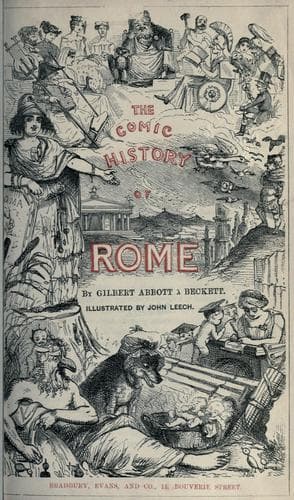
The Comic History of RomeÀ Beckett, Gilbert Abbott
History
The Comic History of Rome
À Beckett, Gilbert Abbott
Rome -- History -- Humor; Wit and humor, Pictorial
It happened that there had been such a run on the banks of the Tiber,
that its coffers or coffer-dams had poured out their contents all over
the adjacent plains, and caused a very extensive distribution of its
currency. Among other valuable deposits, it chanced to lodge for
security, in a branch connected with the bank, the children of Rhea
Silvia, who, by the way, must have been very fortunate under the
circumstances, in being able to keep a balance. The infants were not in
a very enviable condition; for there was nobody to board and lodge them,
though the Tiber was still at hand to wash and do for them. The high
tide proved a tide of good fortune to the children, who were floated so
far inland, that when the river receded, they were left high and dry at
the foot of a fig[3] tree, with no one, apparently, to care a fig what
became of them. Under these circumstances a she-wolf, who had gone down
to the Tiber to drink, heard the whimpering of the babies among the
trees, and, her attention being drawn off from the water in the river to
the whine in the wood, she came forward in the most handsome manner in
the capacity of a wet-nurse to give them suck and succour. How this wolf
became possessed of so much of the milk of human kindness, does not
appear, and it is not perhaps worth while to inquire.
The children, it is said, were awakened by receiving a gentle licking
from the tongue of the animal standing _in loco parentis_ over them.
Finding the situation damp, the wolf removed the infants to her den,
where they were visited by a philanthropic woodpecker; who, when they
were hungry, would bring them some tempting grub, or worm, by which the
woodpecker soon wormed itself into the children's confidence. Other
members of the feathered tribe made themselves useful in this novel
nursery, by keeping off the insects; and many a gnat found itself--or
rather lost itself--unexpectedly in the throat of some remorseless
swallow. However well-meaning the animal may have been, the children
could not have profited greatly, if there had been no one ready to take
them from the month; and happily Faustulus, the king's shepherd, who had
watched them as they were being carried to the wolf's cave or loup-hole,
provided them with another loophole to get out of it. Taking advantage
of the wolf's temporary absence from home, the "gentle shepherd,"
resolving to rescue the children, by hook or by crook, removed the babes
to his own hut, and handed them over to his wife Laurentia, as a sort of
supplement to their previously rather extensive family.
Some historians, refusing to believe the story of the Wolf and the
Woodpecker, have endeavoured to reconcile probability with tradition, by
suggesting that the wife of Faustulus had got the name of the Wolf from
the contrast she presented to her lamb-like husband, and that the
supposed woodpecker was simply a hen-pecker, in the person of
Laurentia.
[Illustration: Romulus consulting the Augury.]
Public-domain text, read in full here on John Shaqi.
Reviews
Reviews
No reviews yet
Be the first to share your thoughts on this work.
Join the Discussion
Join the discussion
Sign in to leave a comment or review.
Sign InorCreate an account