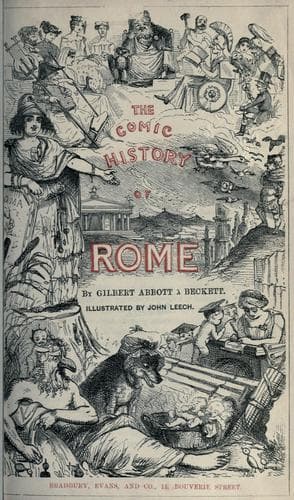
The Comic History of RomeÀ Beckett, Gilbert Abbott
History
The Comic History of Rome
À Beckett, Gilbert Abbott
Rome -- History -- Humor; Wit and humor, Pictorial
On the death of Numa, the country having been taught, by past
experience, the danger of allowing the crown to go from head to head,
without the slightest regard to a fit, determined that the interregnum
should be short, and the election of a new king was at once proceeded
with. The choice fell upon Tullus Hostilius, who was of a decidedly
warlike turn, and was ever on the look-out for a pretext to commence
hostilities. The Albans, our old friends of Alba Longa, or White's Row,
were the nearest, and consequently the most conveniently situated, for
the indulgence of his pugnacious propensities; and tradition relates
that on one occasion some Alban peasants, having been attacked and
stripped by the Romans, the former, who had lost even their clothes,
sought redress at the hands of their rulers. In the course of an attempt
to settle the dispute between Alba and Rome, each place sent
ambassadors, who crossed each other on the road, as if the two states
were determined to be in every way at cross purposes. The Alban envoys
were beguiled of all ideas of business by invitations to banquets and
feasts, so that whenever they attempted to ask for explanations, their
mouths were stopped with a dinner or a supper, given in honour of their
visit. The Roman messengers were prohibited, on the contrary, from
accepting invitations, or giving up to parties what was meant for
Romankind; and had received peremptory instructions to demand an
immediate settlement of their long-standing account from the Albans. The
parties could not understand each other, or, rather, they understood
each other too well; for war was the object of both, though neither of
them liked the responsibility of beginning it. The Albans, however,
prepared to march on Rome, and encamped themselves within the confines
of a ditch, into which ditch their King, Cluilius, tumbled, one night,
very mysteriously, and died, which caused them to dignify the ditch with
the name of _fossa Cluilia_.
[Illustration: Death of Cluilius.]
The Albans appointed one Mettius Fuffetius, a fussy and nervous
personage, as Dictator, in the place of the late King; and Fuffetius
requested an interview with Tullus, who agreed to the proposition, with
a determination, before meeting the Dictator, not to be dictated to.
Mettius represented the inconvenience of wasting whole rivers of blood,
when a few pints might answer all the purpose; and it was finally agreed
to settle the matter by a grand combat of six, sustained on either side
by three champions, chosen from each army. The Alban and the Roman
forces were graced, respectively, with a trio of brothers, whose
strength and activity rendered them worthy to be ranked with the small
family parties who attach the epithet of Herculean, Acrobatic, Indian
rubber, or Incredible, to the fraternal character in which they come
forward to astonish and amuse the enlightened age we live in.
Public-domain text, read in full here on John Shaqi.
Reviews
Reviews
No reviews yet
Be the first to share your thoughts on this work.
Join the Discussion
Join the discussion
Sign in to leave a comment or review.
Sign InorCreate an account