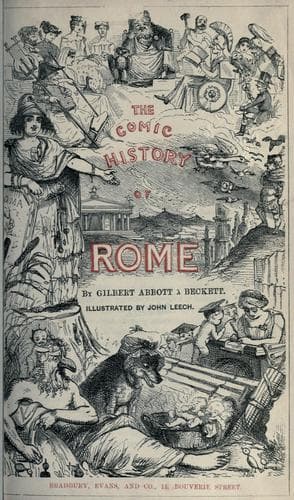
The Comic History of RomeÀ Beckett, Gilbert Abbott
History
The Comic History of Rome
À Beckett, Gilbert Abbott
Rome -- History -- Humor; Wit and humor, Pictorial
thread, which an unlucky stitch in his side would have finished off, his
flight was the cause of his coming off in the end with flying colours.
After the first of the Curiatii fell, fatness proved fatal to the other
two, for Horatius, by dealing with them _en gros_, as well as _en
detail_, settled all accounts with both of them.
[Illustration: Combat between the Horatii and Curiatii.]
Seeing the result of the contest, Fuffetius, on the part of the Albans,
gave out that they gave in, and the Romans returned home with Horatius
at their head, carrying--in a huge bundle--the spoils of the Curiatii.
At the entrance of the city he met his sister, who, perceiving among the
spoils, a garment of her late lover, embroidered with a piece of work
from her own hands, commenced another piece of work of a most frantic
and desperate character. Maddened at the sight of the yarn she had spun
for the lost object of her affections, she began spinning another yarn
that threatened to be interminable, if her brother had not soon cut the
thread of it. She called him by all kinds of names but his own, and was,
in fact, as noisy and abusive as a conventional "female in distress,"
or, as that alarming and dangerous nuisance, "an injured woman."
Horatius, who had found the blades of three assailants less cutting than
a sister's tongue, interrupted her as she ran through her wrongs, by
running her through with his sword, accompanying the act with the
exclamation, "Thus perish all the enemies of Rome." Notwithstanding the
excitement and _éclat_ attending the triumphant entry of Horatius into
Rome, the proper officer of the period, whoever he may have been, was
evidently not only on duty, but prepared to do it, for the victorious
fratricide, or sororicide, was at once hurried off to the nearest Roman
station. Having been taken before the king, his majesty saw great
difficulties in the case, and was puzzled how to dispose of it. Taking
out the scales of justice, he threw the heavy crime of Horatius into
one; but the services performed for his country, when cast into the
other scale, seemed to balance the matter pretty evenly. Tullus,
therefore, referred the case to another tribunal, which sentenced the
culprit to be hanged, but he was allowed to have so capitally acquitted
himself in the fight, that he was acquitted of the capital punishment.
This was commuted for the penalty of passing under the yoke, which
consisted of the ceremony of walking under a pike raised upright on two
others, and at these three pikes the only toll placed upon his crime was
levied.
Public-domain text, read in full here on John Shaqi.
Reviews
Reviews
No reviews yet
Be the first to share your thoughts on this work.
Join the Discussion
Join the discussion
Sign in to leave a comment or review.
Sign InorCreate an account