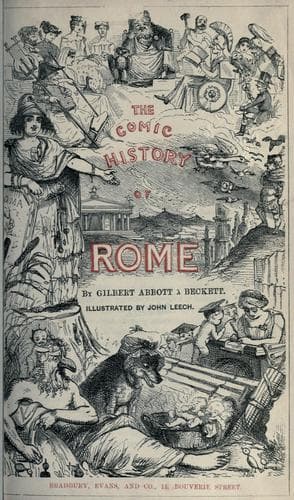
The Comic History of RomeÀ Beckett, Gilbert Abbott
History
The Comic History of Rome
À Beckett, Gilbert Abbott
Rome -- History -- Humor; Wit and humor, Pictorial
The fallen warriors were honoured with tombs in the form of
sugar-loaves, by which the unsatisfactory sweets of posthumous renown
were symbolised. Fuffetius, who though not wounded in his person, was
fearfully wounded in his pride by the result of the conflict, felt so
jealous of Tullus, that the former, though afraid to burst into open
revolt, determined on the really more revolting plan of treachery. The
rival soldiers had now to combine their forces against the Veientines
and the Fidenates, and, having set out together, they soon found the foe
drawn up in battle array, when Tullus with his Romans faced the
Veientines, and Mettius with his Albans formed a _vis à vis_ to the
Fidenates. When the conflict commenced, the Alban wing showed the white
feather, and Fuffetius gradually withdrew his forces to an adjacent
hill, which he lowered himself by ascending for the purpose of watching
the turn of events, so that he might declare himself on the side of
victory. Tullus saw the unmanly manœuvre, but winked at it, and rushed
like winking upon the Fidenates, who ran so fast that their discretion
completely out-ran their valour. The Roman leader then turned his eyes,
arms, and legs towards the Veientines, who fled towards the Tiber, into
which they desperately dived, but many of them, for divers reasons,
never got out again. The perfidious Albans, headed by Mettius Fuffetius,
now came down into the plain, and putting on a plain, straightforward
manner, he congratulated Tullus on the victory. Pretending not to have
noticed their treachery, he invited them all to a sacrifice on the
following day, and having particularly requested them to come early,
they were on the ground by sunrise, but were completely in the dark as
to the intentions of T. Hostilius. The Romans at a given signal closed
in upon the Albans, who were informed that their city should be razed,
or rather, lowered to the ground, and, that their chief, who had pulled
a different way from his new ally, should be fastened to horses who
should be driven in opposite directions. This cruel sentence, upon which
we have scarcely patience to bestow a sentence of our own, was
barbarously carried into execution. Alba fell to the ground; which is
all we have been able to pick up relating to the subject of this portion
of our history.
Public-domain text, read in full here on John Shaqi.
Reviews
Reviews
No reviews yet
Be the first to share your thoughts on this work.
Join the Discussion
Join the discussion
Sign in to leave a comment or review.
Sign InorCreate an account