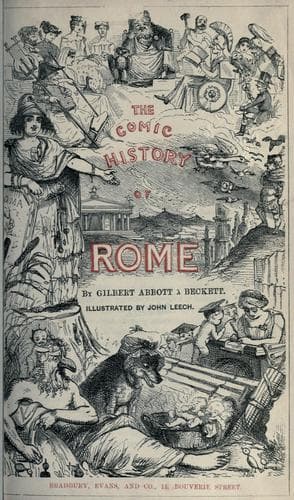
The Comic History of RomeÀ Beckett, Gilbert Abbott
History
The Comic History of Rome
À Beckett, Gilbert Abbott
Rome -- History -- Humor; Wit and humor, Pictorial
The remainder of the reign of Hostilius was occupied with military
successes; but he neglected the worship of the gods, who it is said
evinced their anger by a tremendous shower of stones on the Alban Mount,
in order to soften his flinty heart, by making him feel the weight of
their displeasure. From the extreme of indifference he went to the
opposite extreme of superstition, and called upon Jupiter to send him a
sign--which was, in fact, a sign of the King's head being in a
lamentable condition. The unhappy sovereign, imitating his predecessor
Numa, attempted some experiments in the hope of drawing down some
lightning, but it was not likely that one who had conducted himself so
badly could be a better conductor of the electric fluid, and the result
was, that though he learned the art of attracting the spark, it flashed
upon him with such force that he instantly expired.
Such is the tradition with reference to the death of Tullus; but it is
hard to say whether the accounts handed down to us have been
overcharged, or whether the clouds were in that condition. Some
speculators insinuate that the royal experimentalist owed his sad fate
to some mismanagement of his electrical jar while attempting to produce
an unnatural jarring of the elements. The good actions of Tullus were so
few, that his fame will not afford the omission of one, and being
desirous to put the best construction we can upon his works, we give him
credit for the construction of the Curia Hostilia, whose site still
meets the eye near the northern angle of the Palatine. Ambassadors are
spoken of as existing in the reign of Tullus Hostilius, but whether they
owe their origin to Numa, who went before, or to Ancus Martius, who came
after him, is so much a matter of doubt, that some historians, in trying
to meet the claims of both half-way, stop short of giving the merit to
either. Tullus may, at all events, have the credit of employing, if he
did not institute, the art of diplomacy in Rome; for he appointed
ambassadors, as we have already seen, to negotiate with the Albans.
These envoys were called Feciales, the chief of whom wore on his head a
fillet of white wool, with a quantity of green herbs, formed into a
turban, which must have had somewhat the appearance of a fillet of veal,
with the ingredients for stuffing. His duty was to proceed to the
offending country, and proclaim his wrongs upon the border, though there
might be no one there to listen, and having crossed the boundary--if his
indignation happened to know any bounds--he was to astonish the first
native he met by a catalogue of grievances. On reaching a city, the
ambassador went over the old story to the soldier at the gate, just as
though, at Storey's gate, an irritated foreigner should pour out his
country's real or imaginary wrongs to the sentinel on duty. To this
recital the soldier would, of course, be as deaf as his post, and the
Fecialis would then proceed to lay his complaint before the magistrates.
Public-domain text, read in full here on John Shaqi.
Reviews
Reviews
No reviews yet
Be the first to share your thoughts on this work.
Join the Discussion
Join the discussion
Sign in to leave a comment or review.
Sign InorCreate an account