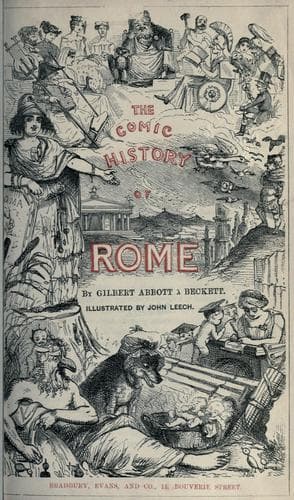
The Comic History of RomeÀ Beckett, Gilbert Abbott
History
The Comic History of Rome
À Beckett, Gilbert Abbott
Rome -- History -- Humor; Wit and humor, Pictorial
In the event of his obtaining no redress, he returned home for a spear,
and killing a pig with one end, he poked the fire with the other. The
instrument being thus charred in the handle and blood-stained at the
point, became an appropriate emblem of hostility, and the Fecialis
declared war by stirring it up with the long pole, which he threw across
the enemy's boundary.
After the death of Tullus Hostilius, the people lost no time in choosing
Ancus Martius, a grandson of Numa, for their sovereign. The new king
copied his grandfather, which he had a perfect right to do, but he
imposed on the Pontifex Maximus the very severe task of copying on white
tables the somewhat ponderous works of Pompilius, which were posted up
for the perusal of the populace.
Though partial on the whole to peace, Ancus was not afraid of war, and,
when his kingdom was threatened, he was quite ready to fight for it. He
subdued the Latins, and having first settled them in the field, allowed
them to settle themselves in the city. He enlarged Rome, but abridged
the distance between different parts by throwing the first bridge across
the Tiber, and his name has come down to posterity in the ditch of the
Quirites which he caused to be dug for the defence of the city, against
those who were unlikely to go through thick and thin for the purpose of
invading it. He also built a prison in the heart of the city, and what
might be truly termed a heart of stone, for the prison was formed of a
quarry, and is still in existence as a monument of the hard lot of its
inmates. Ancus Martius further signalised his reign by founding the city
of Ostia at the Tiber's mouth, and thus gave its waters the benefit of
that port which so much increased their value. On the spot may still be
seen some ruins supposed to belong to a temple dedicated to the winds,
among whom the greater part of the temple has long since been
promiscuously scattered. Salt-works were also established in its
neighbourhood, but the _sal_ was of that volatile kind that none now
remains from which buyers could fill their cellars. Ancus Martius
reigned for a period of twenty-four years, and either in tranquillity or
war--whether engaged in the works of peace, or embroiled in a piece of
work--he proved himself thoroughly worthy of his predecessors, and, in
fact, he left far behind him many who had gone before him in the task of
government.
FOOTNOTES:
[8] Val. Maximùs, i. 1. § 4.
[9] There exist, in the British Museum, books older than the time of
Numa, written by the Egyptians, on these palm leaves, which show, in one
sense, the palmy state of literature at that early period.
CHAPTER THE THIRD.
FROM THE ACCESSION OF TARQUINIUS PRISCUS TO THE DEATH OF SERVIUS
TULLIUS.
[Illustration]
Public-domain text, read in full here on John Shaqi.
Reviews
Reviews
No reviews yet
Be the first to share your thoughts on this work.
Join the Discussion
Join the discussion
Sign in to leave a comment or review.
Sign InorCreate an account