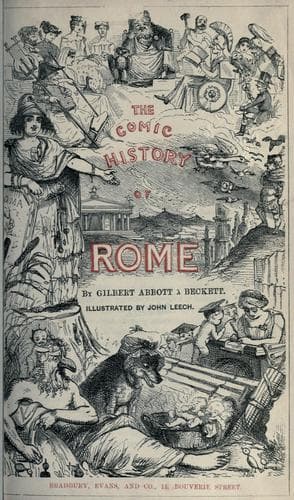
The Comic History of RomeÀ Beckett, Gilbert Abbott
History
The Comic History of Rome
À Beckett, Gilbert Abbott
Rome -- History -- Humor; Wit and humor, Pictorial
It is the opinion of the best authorities that the Muse of History has
employed her skipping-rope in passing, or rather skipping, from the
grave of Ancus Martius to the throne of Tarquinius Priscus; for there is
a very visible gap yawning between the two; and as we have no wish to
set the reader yawning in sympathy with the gap, we at once drag him
away from it.
Plunging into the times of Tarquinius Priscus, we describe him as the
son of a Corinthian merchant, who, being compelled to quit his country
for political reasons, had withdrawn all his Corinthian capital, and
settled at Tarquinii, an Etruscan city. Having fallen in love with a
lady of the place, or, more poetically speaking, deposited his
affections in an Etruscan vase, he became a husband to her, and the
father of two children, named respectively Lucumo and Aruns. Poor Aruns
had a very brief run, and soon met his death; but we cannot say how or
where, for we have no report of the meeting. Lucumo married Tanaquil, an
Etruscan lady, of great beauty and ambition, who professed to dive into
futurity; and, guided by this diving belle, he threw himself into the
stream of events, in the hope of being carried onwards by the tide of
fortune. She persuaded him that Tarquinii was a poor place, where
nothing was to be done; that his foreign extraction prevented him from
being properly drawn out; and that Rome alone could afford him a field
wide enough for his vast abilities. Driven by his wife, he jumped up
into his chariot, which was an open one, and was just entering Rome,
when his cap was suddenly removed from his head by a strange bird, which
some allege was an eagle; though, had they said it was a lark, we should
have believed them far more readily. Lucumo followed his hat as well as
he could with his eyes; but his wife was so completely carried away with
it, that she declared the circumstance told her he would gain a crown,
though it really proved how nearly he had lost one; for until the bird
replaced his hat upon his head, there was only a bare possibility of his
getting it back again.
The wealth of his wife enabled Lucumo to live in the first style of
fashion; and having been admitted to the rights of citizenship, he
changed his name to Lucius Tarquinius: for the sake, perhaps, of the
sound, in the absence of any sounder reason. He was introduced at Court,
where he won the favour of Ancus, who was so much taken by his dashing
exterior, that he gave him a commission in the army, as Tribunus
Celerum, a sort of Captain of the Guards, who, from the title of
Celeres, appear to have been, as we have before observed, the fast men,
as opposed to the "slow coaches" of the period.
[Illustration: Celeres.]
Public-domain text, read in full here on John Shaqi.
Reviews
Reviews
No reviews yet
Be the first to share your thoughts on this work.
Join the Discussion
Join the discussion
Sign in to leave a comment or review.
Sign InorCreate an account