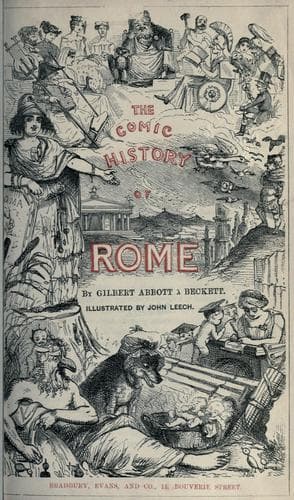
The Comic History of RomeÀ Beckett, Gilbert Abbott
History
The Comic History of Rome
À Beckett, Gilbert Abbott
Rome -- History -- Humor; Wit and humor, Pictorial
The Captain made himself so generally useful to Ancus, that when the
latter died, his two sons were left to the guardianship of the former,
who, on the day fixed for the election of a new king, sent his wards to
the chase, that they might be pursuing other game, instead of looking
after the Crown, which Tarquinius had set his own eye upon. In the
absence of the youths, Tarquinius, who had got the name of Priscus, or
the old hand, which he seems to have well deserved, proposed himself as
a candidate; and, in a capital electioneering speech, put forth his own
merits with such success, that he was voted on to the throne without
opposition.
The commencement of his reign was not very peaceful, for he was attacked
by the Latins; but he gave them a very severe Latin lesson, and,
crushing them under his feet, sent them back to that part of Italy
forming the lower part of the boot, with the loss of considerable booty.
He, nevertheless, found time for all manner of games; and he instituted
the Ludi Magni, which were great sport, in a space he marked out as the
Circus Maximus.
The position of the Circus was between the Palatine and Aventine Hills,
there being a slope on either side, so that the people followed the
inclination of nature as well as their own in selecting the spot for
spectacular purposes. In the earliest times a Circus was formed of
materials brought by the spectators themselves, who raised temporary
scaffolds, from which an unfortunate drop, causing fearful execution
among the crowd, would frequently happen. Tarquinius Priscus, desirous
of giving more permanent accommodation to the Roman sight seers, built a
Circus capable of containing 150,000 persons, and, from its vast
superiority in size over other similar buildings, it obtained the
distinction of Maximus. The sports of the Circus were extremely
attractive to the Romans, who looked to the _libelli_, containing the
lists of the horses, and names and colours of the drivers, with all the
eagerness of a "gentleman sportsman" seeking information from Dorling's
correct card at Epsom. In the early days of Rome the amusements of the
Circus were limited to the comparatively harmless contests of equestrian
speed; and it was not until the city had reached a high state of
refinement--cruelty having become refined like everything else--that
animals were killed by thousands, and human beings by hundreds at a
time, to glut the sanguinary appetites of the prince and the people. The
ancient Circus was circular at one end only, and the line of seats was
broken by a sort of outwork, supposed to have comprised the box and
retiring-room of the sovereign; while, at the opposite side, was another
deviation from the line of seats, to form a place for the _editor
spectaculorum_--a box for the manager. Though Tarquinius is said to have
founded the Circus Maximus in commemoration of his victory over the
Latins, they were not the only foes whom he might have boasted of
vanquishing.
Public-domain text, read in full here on John Shaqi.
Reviews
Reviews
No reviews yet
Be the first to share your thoughts on this work.
Join the Discussion
Join the discussion
Sign in to leave a comment or review.
Sign InorCreate an account