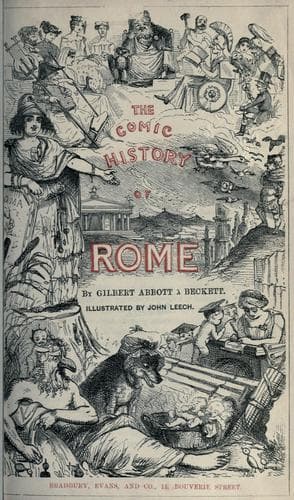
The Comic History of RomeÀ Beckett, Gilbert Abbott
History
The Comic History of Rome
À Beckett, Gilbert Abbott
Rome -- History -- Humor; Wit and humor, Pictorial
Tarquinius had reigned about thirty-eight years, when the sons of Ancus
Martius, who had been from the first brooding over their own ejection
from the throne, carried their brooding so far as to hatch a conspiracy,
which, though regarded by the best authorities as a mare's nest, forms
one of those "lays" of ancient Rome which tradition gives as part of her
history. The youths, expecting that Tarquinius would secure the
succession to a favourite, named Servius Tullius, made an arrangement
with a couple of shepherds, who, pretending to have a quarrel, went with
hatchets in their hands to the king, and requested him to settle their
little difference. Tarquinius seems to have been in a most accommodating
humour, for he is said to have stepped to the door of the palace, to
arbitrate between these most un-gentle shepherds, who, pretending that
they only came with their hatchets to axe his advice, began to axe him
about the head; and while he was endeavouring to act as an arbitrator,
they, acting as still greater traitors, cruelly made away with him. The
lictors who stood by must have had their faces and their fasces turned
the wrong way, for they administered a beating to the shepherds when,
too late, after the regal crown was already cracked beyond the
possibility of repair, and the king was almost knocked to pieces before
he had time to collect himself.
Tarquinius was a practical reformer, and rested his fame on the most
durable foundations, among which the still-existing remains of the
Cloaca Maxima, or largest common sewer, have already been noticed. Those
who are over nice might feel repugnant to come down to posterity by such
a channel; but that country is fortunate indeed in which genius seeks
"the bubble reputation" at the mouth of the sewer, instead of in the
mouth of the cannon.
It must be recorded, to the honour of Tarquinius, that he organised the
plebeians, and elevated some of them to the rank of patricians, thus
giving vigour to the aristocratic body, which runs the risk of becoming
corrupt, and losing its vitality, unless a supply of plebeian life-blood
is from time to time poured into it.
This measure would have been followed by other wholesome reforms, but
for the short-sighted and selfish policy of the patricians themselves,
who could not perceive the fact, full of apparent paradoxes, that if
anything is to remain, it must not stand still; that no station can be
stationary with safety to itself; and that nothing possessed of vitality
can grow old without something new being continually added.
Public-domain text, read in full here on John Shaqi.
Reviews
Reviews
No reviews yet
Be the first to share your thoughts on this work.
Join the Discussion
Join the discussion
Sign in to leave a comment or review.
Sign InorCreate an account