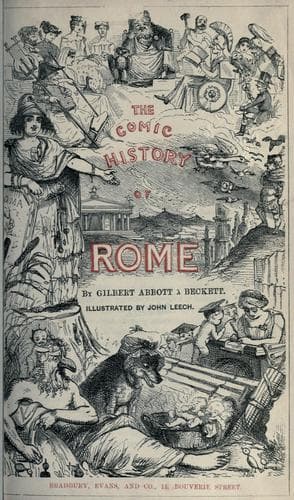
The Comic History of RomeÀ Beckett, Gilbert Abbott
History
The Comic History of Rome
À Beckett, Gilbert Abbott
Rome -- History -- Humor; Wit and humor, Pictorial
The sixth king of Rome was Servius Tullius, who is said to have been the
son of a female in the establishment of Tanaquil. His mother's name was
Ocrisia; but there is something vague about the paternity of the boy,
which has been assigned sometimes to the Lar, or household god of the
establishment, and sometimes to Vulcan. Whoever may have been the
father, it was soon intimated that the child was to occupy a high
position; and on one occasion, when sleeping in his cradle, his head was
seen to be on fire; but no one was allowed to blow out the poor boy's
brains, or otherwise extinguish the flame, which was rapidly consuming
the hair on the head of the future heir to the monarchy. The nurses and
attendants were ordered to sit down and see the fire burn out of its own
accord, which, the tradition says, it did, though common sense says it
couldn't; for the unfortunate infant must have died of consumption had
he been suffered to blaze away in the cool manner spoken of. Though of
common origin, at least on his mother's side, young Servius Tullius was
supposed to have been completely purified by the fire, which warmed the
hearts of all who came near him; and not only did the queen adopt him as
her own son, but the partial baking had produced such an effect upon his
very ordinary clay, that he was treated like a brick required for the
foundations of the royal house into which Tarquinius cemented him, by
giving him, as a wife, one of the daughters of the royal family.
Tanaquil having kept secret her husband's death, Servius Tullius
continued for some time to carry on the business of government, just as
if nothing had happened. When it was at length felt that the young
favourite of fortune had got the reins fairly in his hands, the murder
came out, and the barbarous assassination of Tarquinius was published to
the multitude. Servius was the first instance of a king who mounted the
throne without the aid of the customary pair of steps, consisting of an
election by the Senate, and a confirmation by the Curiæ.
Public-domain text, read in full here on John Shaqi.
Reviews
Reviews
No reviews yet
Be the first to share your thoughts on this work.
Join the Discussion
Join the discussion
Sign in to leave a comment or review.
Sign InorCreate an account