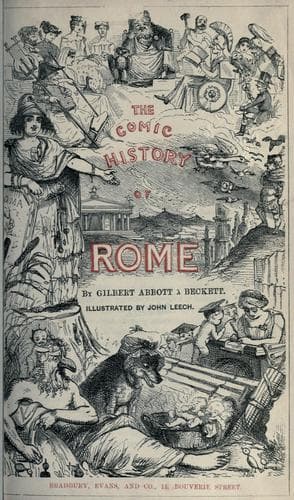
The Comic History of RomeÀ Beckett, Gilbert Abbott
History
The Comic History of Rome
À Beckett, Gilbert Abbott
Rome -- History -- Humor; Wit and humor, Pictorial
Among the early Romans, the most honourable occupations were agriculture
and war; the latter enabling the citizens to make a conquest of the soil
with the sword, and the former teaching them to subdue it to their
purposes by the implements of husbandry. Trade and commerce were held in
contempt, and left to the plebeians; the patrician considering himself
suitably employed only when he was thrashing his corn, or performing the
same operation on his enemies.
During the early existence of the city the native artists were few, and
the great works of architecture undertaken by the later kings were
embellished by foreign talent from Etruria. The writing-master had made
so little progress in ancient Rome, that it is doubtful whether many of
the patricians could write their own names; and even some of the most
distinguished characters of the day were men of mark, not only by their
position, but by their signatures.
It is not very gratifying to the friends of education to find that
though ignorance was almost universal among the early Romans, there was
a wholesome tone of morality among the people, which led them, not only
to condemn in their traditions the cruelty and laxity of principle
prevailing in the family of their last king, but to pay due reverence to
the domestic virtues of Lucretia. The legend of the latter being found
spinning with her maids, while the princesses of the house of Tarquin
were reeling in the dance, during the absence of their respective
husbands, is sufficient to show the estimation in which decency and
sobriety were held, as well as the odium that attached to riotous
revelry. The patrician youth of infant and unlettered Rome would have
been ashamed of those nocturnal gambols which have prevailed among
portions of the juvenile aristocracy and gentry in more civilised
countries, and in a more enlightened age, when door-knockers, and
bell-handles, have been carried off as the _spolia opima_ of some
disorderly triumph.
[Illustration]
FOOTNOTES:
[10] Some say that Tarquinius Priscus bought the books; but it is of
little consequence who was the real buyer, as the whole story is very
probably "a sell" on the part of the narrators, as well as of the sibyl.
[11] Cicero. It is true this was said at a much later time than that of
which we are now writing; but dancing, except in connection with certain
ceremonies, was considered degrading by the Romans from the earliest
period.
[12] Hence, from the word _pecus_, cattle, was derived _pecunia_,
signifying money, and giving rise to our own word "pecuniary."
CHAPTER THE FIFTH.
FROM THE BANISHMENT OF TARQUINIUS SUPERBUS TO THE BATTLE OF LAKE
REGILLUS.
[Illustration]
Public-domain text, read in full here on John Shaqi.
Reviews
Reviews
No reviews yet
Be the first to share your thoughts on this work.
Join the Discussion
Join the discussion
Sign in to leave a comment or review.
Sign InorCreate an account