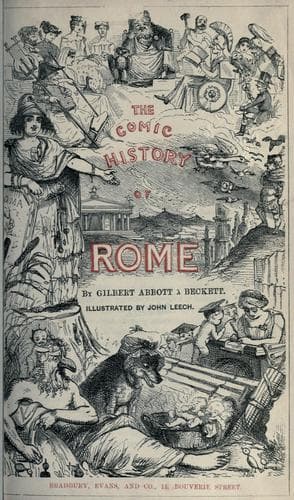
The Comic History of RomeÀ Beckett, Gilbert Abbott
History
The Comic History of Rome
À Beckett, Gilbert Abbott
Rome -- History -- Humor; Wit and humor, Pictorial
Brutus, who had gained his eminence by swearing that there should be no
monarch or single ruler in Rome, found himself in sole possession of the
supreme authority. His position presents nothing very remarkable to the
modern observer, who is accustomed to see those who have denounced a
system yesterday participating in the profits of the same system to-day,
and declaring their own arguments to be thoroughly out of place, as
applied to themselves when in office. Brutus, however, could not
consistently exercise a power he had sworn to overthrow; and to carry
out his anti-monarchical principles, he had either to go out himself, or
to ask for a colleague. On the same principle that prefers the half
quartern to utter loaflessness, Brutus proposed a partnership in the
government; and Collatinus was taken into the firm, which proved to have
no firmness at all, for it was dissolved very speedily. The difficulty
of agreement between two of the same trade was severely felt by the two
popular reformers, who were dividing the substance without the name of
that power they had vowed to destroy; it was soon evident that if they
had thought it too much for one, they considered it not enough for two;
and they were accordingly always quarrelling. To prevent collision, they
tried the experiment of taking the supreme authority by turns, each
assuming the fasces for a month at a time; but this alternate chopping
of the regal sticks, or fasces, which were the emblems of power, led to
nothing satisfactory.
A question at length arose, upon which the duality of the ruling mind
was so distinctly marked, that the two consuls, whose very name is
derived from _con_, with, and _salio_, to leap, were trying to leap in
two opposite ways; and an end of their own power was the only conclusion
to which they were likely to jump together. Tarquin had retired to
Caere, waiting the chances of a restoration of his line; but his line
had fallen into such contempt, that he was fishing in vain for his
recall, though he nevertheless sent ambassadors to demand the
restoration of himself, or at all events of his private property.
The senate decreed that though Tarquin could not have the fasces, he was
at liberty to make a bundle of all the other sticks that might belong to
him. On this question Brutus and Collatinus were violently opposed, and
both becoming hot, their excessive warmth led to a mutual coolness that
ended in an open hostility, which shut out every hope of compromise.
Collatinus gave in by going out, and was succeeded by P. Valerius, one
of the party of four who had roused the popular spirit over the bier of
Lucretia.
Public-domain text, read in full here on John Shaqi.
Reviews
Reviews
No reviews yet
Be the first to share your thoughts on this work.
Join the Discussion
Join the discussion
Sign in to leave a comment or review.
Sign InorCreate an account