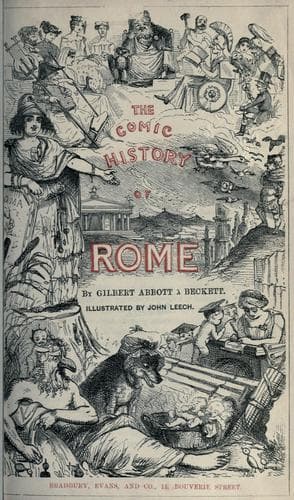
The Comic History of RomeÀ Beckett, Gilbert Abbott
History
The Comic History of Rome
À Beckett, Gilbert Abbott
Rome -- History -- Humor; Wit and humor, Pictorial
Tarquin's ambassadors, instead of being satisfied with the permission to
remove his goods, had other objects in the back-ground; for they had a
plan for his restoration in the rear, while they let nothing appear in
the van, but the late king's furniture. The plot was being discussed
after dinner, by a party of the conspirators, when one of the waiters,
who had concealed himself behind the door, overheard the scheme, and ran
to Valerius with the exclusive intelligence. The traitors were secured,
and when they were brought up before the consuls, Brutus recognising
among the offenders his two sons, subjected both them and himself to a
very severe trial. Asking them what they had to say to the charge, and
getting "nothing" in reply, he looked in the faces of his sons, and
declaring that he must class all malefactors under one general head,
which must be cut off, he called upon the lictors to do their duty. In
leaving the other prisoners to be tried by Valerius, Brutus whispered to
his colleague, "Now try them, and acquit them, if you can;" but he could
only execute the law, and the law could only execute the criminals. The
ambassadors were allowed to remain at large, though their plotting
proved that they had been at something very little; and the government
withdrew the permission that had been granted for the removal of
Tarquin's goods, which were divided by means of a scramble among the
populace.
Thus Tarquin, who had broken the twenty valuable tables of Servius, was
doomed to have the tables turned upon him by the destruction of his own,
while every leaf of the former was restored under the Consular
government. The landed estates of the Tarquins were distributed among
the plebeians, so that the banished family had no chance of recovering
their lost ground, which was afterwards known as the Field of Mars, or
Campus Martius. The corn on the confiscated property was ripe; but the
people felt a conscientious objection to consuming the produce which no
labour of their own had reared; and they did not allow the tyrant's
grain to outweigh their honest scruple. Throwing all idea of profit
overboard, they cast the corn into the Tiber, which, it is said, was so
shallow, that the sheaves stuck in the mud, and formed the small island
known as the Insula Tiberina. That a piece of land, however small,
should be formed by a crop of corn, however plentiful, is difficult to
believe: but the story of the wheat can only find reception from the
very longest ears; for common sense will admit that in the effort to
give credit to the tale, it must go thoroughly against the grain on a
proper sifting of all the evidence.
Public-domain text, read in full here on John Shaqi.
Reviews
Reviews
No reviews yet
Be the first to share your thoughts on this work.
Join the Discussion
Join the discussion
Sign in to leave a comment or review.
Sign InorCreate an account