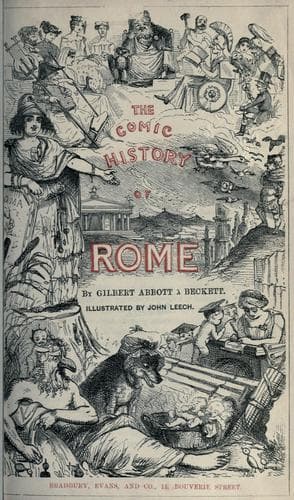
The Comic History of RomeÀ Beckett, Gilbert Abbott
History
The Comic History of Rome
À Beckett, Gilbert Abbott
Rome -- History -- Humor; Wit and humor, Pictorial
Tarquin relinquishing his hopes of a restoration by stratagem, resolved
on resorting to strategy, and brought into the field a large army, of
which the Veii formed a considerable part, and his son Aruns headed the
Etruscan cavalry. The Roman consuls commanded their own forces; Valerius
being at the head of the foot, and Brutus mounted on a clever cob, with
a strong sword, that might be called a useful hack, taking the lead of
the equestrians. When Aruns entered the field, he recognised Brutus in
Tarquin's cloak, and the young man felt the blood mantling with
indignation into his cheek at the first sight of the mantle. He
instantly made for Brutus, who with equal eagerness made for Aruns, and
so violent was the collision, that the breath was knocked at one blow
out of both their bodies.
[Illustration: Aruns and Brutus.]
The hostile leaders having fallen to the ground, the battle shared their
fate, and both armies withdrew to their camps; but neither would allow
the other the credit of a victory. The legend goes on to state that the
god Silvanus--an alarmist among the classical deities, and synonymous
with Pan--was heard shouting in the night that the Etruscans having lost
one man more than the Romans, the latter had gained the battle. This
announcement of the result of the contest, though only by a majority of
one, so alarmed the Etruscans, who were always panic struck at the voice
of Pan, that they took to flight, leaving the enemy to carry everything
before them, including all the property that the fugitives had left
behind them. The remains of Brutus were brought to the Forum, where they
lay in state; but the state in which they lay was truly deplorable; for
the deceased consul had been so knocked about, that had he been alive,
he would scarcely have known himself, even by the aid of reflection. His
colleague, Valerius, delivered an oration over his departed virtues,
making a catalogue of the whole, and fixing the highest price to every
one of them.
The question of "Shall Brutus have a statue?" was soon answered in the
affirmative, and he was placed among the kings, though he had destroyed
the monarchy. Where failure constitutes the traitor, success makes the
patriot: and upon the merest accident may depend the question whether
the originator of a design against a bad government shall go to the
block of the sculptor, or to that of the executioner.
Public-domain text, read in full here on John Shaqi.
Reviews
Reviews
No reviews yet
Be the first to share your thoughts on this work.
Join the Discussion
Join the discussion
Sign in to leave a comment or review.
Sign InorCreate an account