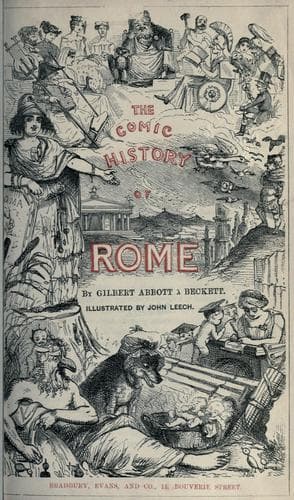
The Comic History of RomeÀ Beckett, Gilbert Abbott
History
The Comic History of Rome
À Beckett, Gilbert Abbott
Rome -- History -- Humor; Wit and humor, Pictorial
P. Valerius was in no hurry to ask the people for a colleague, and he
for some time did the whole of the business of the chief magistracy
himself; so that had it not been for the mere name of the office, Rome
might just as well have remained a monarchy. This fact seems to have
flashed at last on the public mind; and when it was found that P.
Valerius was building himself a stone residence, in a strong position, a
rumour was spread abroad that he was aiming at the foundation of his own
house, or family, in the kingly power. On hearing the report he
immediately stopped the works of his intended residence, and having
called a meeting of the curiæ, he appeared before them with his fasces
reversed; a sign that the bundles of rods were not intended to be used
on the backs of the people alone, but that they were held, as it were,
in trust, and in pickle for the punishment of delinquency in general.
This treatment of the fasces so fascinated the people, that they
acquitted P. Valerius of every charge, and acknowledging their
suspicions of a plot to be groundless, they gave him a plot of ground to
build his house upon. Pleased with the taste of popularity, he continued
to court it with so much success, that he gained the name of Publicola,
or one who honours the public; and he certainly introduced many very
wholesome legal reforms, by dabbling in law, in a spirit truly
lau-dable. He gave an appeal from the magistrate to the people, in cases
where the punishment awarded had been a fine, a whipping, or a hanging;
and in the last instance the provision was extremely salutary, for the
suspending of a sentence might often avoid the necessity for suspending
an alleged criminal. This right of appeal was, however, limited to
within a mile from the city; an arrangement that would have justified
the formation of a league to abolish the mile, as an unnecessary
distinction, of which we can only expose the absurdity, by suggesting
the possibility of an offence committed at Knightsbridge being
punishable at Newgate with immediate death; while the culprit of Holborn
Hill, though nearer the place of execution, would be further from the
scaffold.
Public-domain text, read in full here on John Shaqi.
Reviews
Reviews
No reviews yet
Be the first to share your thoughts on this work.
Join the Discussion
Join the discussion
Sign in to leave a comment or review.
Sign InorCreate an account