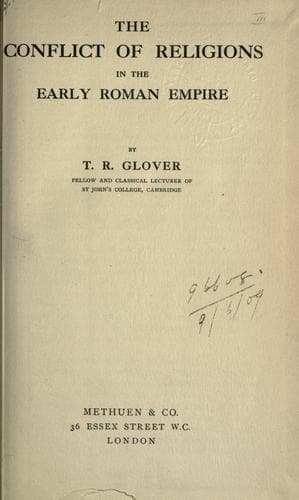
The Conflict of Religions in the Early Roman EmpireGlover, T. R. (Terrot Reaveley)
Religion
The Conflict of Religions in the Early Roman Empire
Glover, T. R. (Terrot Reaveley)
Christianity and other religions; Church history -- Primitive and early church, ca. 30-600; Rome -- Religion
Here was a poet who loved Rome more than ever did Augustus or Horace,
and he had no such speedy cure as they for "the woes of sorrowful
Hesperia." The loss of faith in the old gods meant more to him than to
them, so his tone in speaking of them is quieter, a great deal, than
that of Horace. He took the decline of morals more seriously and more
inwardly, and he saw more deeply into the springs of action; he could
never lightly use the talk of rapid and sweeping reformation, as his
friend did in the odes which the Emperor inspired. He had every belief
in Augustus, who was dearer to him personally than to Horace, and he
hoped for much outcome from the new movement in the State. But with
all his absorbing interest in {29} his own times--and how deep that
interest was, only long and minute study of his poems will reveal--he
was without scheme or policy. He came before his countrymen, as
prophets and poets do in all ages--a child in affairs, but a man in
inward experience; he had little or nothing to offer but the
impressions left upon his soul by human life. He had the advantage
over most prophets in being a "lord of language"; he drew more music
from Latin words than had ever been achieved before or was ever reached
again.
He told men of a new experience of Nature. It is hardly exaggeration
to say that he stands nearer Wordsworth in this feeling than any other
poet. He had the same "impulses of deeper birth"; he had seen new
gleams and heard new voices; he had enjoyed what no Italian had before,
and he spoke in a new way, unintelligible then, and unintelligible
still, to those who have not seen and heard the same things. The gist
of it all he tried to give in the language of Pantheism, which the
Stoics had borrowed from Pythagoras:--"The Deity, they tell us,
pervades all, earth and the expanse of sea, and the deep vault of
heaven; from Him flocks, herds, men, wild beasts of every sort, each
creature at its birth draws the bright thread of life; further, to Him
all things return, are restored and reduced--death has no place among
them; but they fly up alive into the ranks of the stars and take their
seats aloft in the sky." So John Conington did the passage into
English. But in such cases it may be said with no disrespect to the
commentator who has done so much for his poet, the original words stand
to the translation, as Virgil's thought did to the same thought in a
Stoic's brain.
_Deum namque ire per omnis
Terrasque tractusque maris caelumque profundum;
Hinc pecudes, armenta, viros, genus omne ferarum,
Quemque sibi tenues nascentem arcessere vitas;
Scilicet huc reddi deinde ac resoluta referri
Omnia, nec morti esse locum, sed viva volare
Sideris in numerum atque alto succedere caelo_.
(Georgics, iv, 221.)
Public-domain text, read in full here on John Shaqi.
Reviews
Reviews
No reviews yet
Be the first to share your thoughts on this work.
Join the Discussion
Join the discussion
Sign in to leave a comment or review.
Sign InorCreate an account