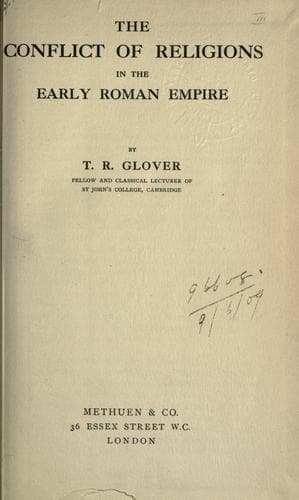
The Conflict of Religions in the Early Roman EmpireGlover, T. R. (Terrot Reaveley)
Religion
The Conflict of Religions in the Early Roman Empire
Glover, T. R. (Terrot Reaveley)
Christianity and other religions; Church history -- Primitive and early church, ca. 30-600; Rome -- Religion
The words might represent a fancy, or a dogma of the schools and many
no doubt so read them, because they had no {30} experience to help
them. But to others it is clear that the passage is one of the deepest
import, for it is the key to Virgil's mind and the thought is an
expression of what we can call by no other name than religion. Around
him men and women were seeking communion with gods; he had had
communion with what he could not name--he had experienced religion in a
very deep, abiding and true way. There is nothing for it--at least for
Englishmen--but to quote the "lines composed a few miles above Tintern
Abbey"--
I have felt
A presence that disturbs me with the joy
Of elevated thoughts; a sense sublime
Of something far more deeply interfused,
Whose dwelling is the light of setting suns,
And the round ocean, and the living air,
And the blue sky, and in the mind of man;
A motion and a spirit, that impels
All thinking things, all objects of all thought,
And rolls through all things.
Virgil's experience did not stop here; like Wordsworth, he found
Nature's self
By all varieties of human love
Assisted.
He had been a son and a brother; and such relations of men to men
impressed him--they took him into the deepest and most beautiful
regions of life; and one of the charms of Italy was that it was written
all over with the records of human love and helpfulness. The clearing,
the orchard, the hilltop town, the bed of flowers, all spoke to him
"words that could not be uttered." His long acquaintance with such
scripts brought it about that he found
in man an object of delight,
Of pure imagination and of love--
and he came to the Roman people with a deep impression of human
worth--something unknown altogether in Roman poetry before or after.
Lucretius was impressed with man's insignificance in the universe;
Horace, with man's folly. Virgil's {31} poetry throbbed with the sense
of man's grandeur and his sanctity.
Public-domain text, read in full here on John Shaqi.
Reviews
Reviews
No reviews yet
Be the first to share your thoughts on this work.
Join the Discussion
Join the discussion
Sign in to leave a comment or review.
Sign InorCreate an account