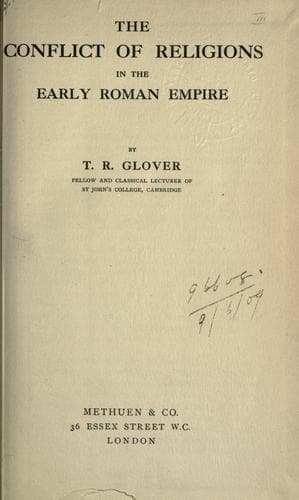
The Conflict of Religions in the Early Roman EmpireGlover, T. R. (Terrot Reaveley)
Religion
The Conflict of Religions in the Early Roman Empire
Glover, T. R. (Terrot Reaveley)
Christianity and other religions; Church history -- Primitive and early church, ca. 30-600; Rome -- Religion
"I am entering," writes Tacitus,[1] "upon the history of a period, rich
in disasters, gloomy with wars, rent with seditions, nay, savage in its
very hours of peace. Four Emperors perished by the sword; there were
three civil wars; there were more with foreigners--and some had both
characters at once.... Rome was wasted by fires, its oldest temples
burnt, the very Capitol set in flames by Roman hands. There was
defilement of sacred rites; adulteries in high places; the sea crowded
with exiles; island rocks drenched with murder. Yet wilder was the
frenzy in Rome; nobility, wealth, the refusal of office, its
acceptance--everything was a crime, and virtue the surest ruin. Nor
were the rewards of informers less odious than their deeds; one found
his spoils in a priesthood or a consulate; another in a provincial
governorship; another behind the throne; and all was one delirium of
hate and terror; slaves were bribed to betray their masters, freedmen
their patrons. He who had no foe was destroyed by his friend."
It was to this that Virgil's hope of a new Golden Age had
come--_Redeunt Saturnia regna_. Augustus had restored the Republic; he
had restored religion; and after a hundred years here is the outcome.
Tacitus himself admits that the age was not "barren of virtues," that
it "could show fine illustrations" of family love and friendship, and
of heroic death. It must also be owned that the Provinces at large
were better governed than under the Republic; and, further, that, when
he wrote Tacitus thought of a particular period of civil disorder and
that not a long one. Yet the reader of his Annals will feel that the
description will cover more than the year 69; it is essentially true of
the reigns of Tiberius, Gaius, Claudius and Nero, and it was to be true
again of the reign of Domitian--of perhaps eighty years of the first
century of our era. If it was not true {34} of the whole Mediterranean
world, or even of the whole of Rome, it was true at least of that
half-Rome which gave its colour to the thinking of the world.
[Sidenote: The Imperial court]
Public-domain text, read in full here on John Shaqi.
Reviews
Reviews
No reviews yet
Be the first to share your thoughts on this work.
Join the Discussion
Join the discussion
Sign in to leave a comment or review.
Sign InorCreate an account