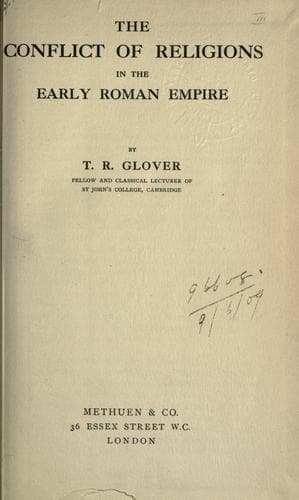
The Conflict of Religions in the Early Roman EmpireGlover, T. R. (Terrot Reaveley)
Religion
The Conflict of Religions in the Early Roman Empire
Glover, T. R. (Terrot Reaveley)
Christianity and other religions; Church history -- Primitive and early church, ca. 30-600; Rome -- Religion
On paper, perhaps, all religions and philosophies may at first glance
seem equally good, and it is not till we test them in life {40} that we
can value them aright. And even here there is a wide field for error.
Every religion has its saints--men recognizable to everyone as saints
in the beauty, manhood and tenderness of their character--and it is
perhaps humiliating to have to acknowledge that very often they seem to
be so through some happy gift of Nature, quite independently of any
effort they make, or of the religion to which they themselves generally
attribute anything that redeems them from being base. We have to take,
if possible, large masses of men, and to see how they are affected by
the religion which we wish to study--average men, as we call them--for
in this way we shall escape being led to hasty conclusions by happy
instances of natural endowment, or of virtues carefully acquired in
favourable circumstances of retirement or helpful environment. Side by
side with such results as we may reach from wider study, we have to set
our saints and heroes, for while St Francis would have been tender and
Thrasea brave under any system of thought, it remains that the one was
Christian and the other Stoic. We need the individual, if we are to
avoid mere rough generalities; but we must be sure that he is
representative in some way of the class and the system under review.
As representatives of the Stoicism of the early Roman Empire, two men
stand out conspicuous--men whose characters may be known with a high
degree of intimacy. The one was a Roman statesman, famous above all
others in his age, and a man of letters--one of those writers who
reveal themselves in every sentence they write and seem to leave
records of every mood they have known. The other was an emancipated
slave, who lived at Nicopolis in Epirus, away from the main channels of
life, who wrote nothing, but whose conversations or monologues were
faithfully recorded by a disciple.
"Notable Seneca," writes Carlyle, "so wistfully desirous to stand well
with Truth and yet not ill with Nero, is and remains only our perhaps
niceliest proportioned half-and-half, the plausiblest Plausible on
record; no great man, no true man, no man at all... 'the father of all
such as wear shovel-hats.'" This was in the essay on Diderot written
in 1833; and we find in his diary for 10th August 1832, when Carlyle
was fresh from reading Seneca, an earlier judgment to much the same
effect--"He is father of all that work in sentimentality, and, by fine
speaking {41} and decent behaviour, study to serve God and mammon, to
stand well with philosophy and not ill with Nero. His _force_ had
mostly oozed out of him, or corrupted itself into _benevolence_,
virtue, sensibility. Oh! the everlasting clatter about virtue!
virtue!! In the Devil's name be virtuous and no more about it."
Public-domain text, read in full here on John Shaqi.
Reviews
Reviews
No reviews yet
Be the first to share your thoughts on this work.
Join the Discussion
Join the discussion
Sign in to leave a comment or review.
Sign InorCreate an account