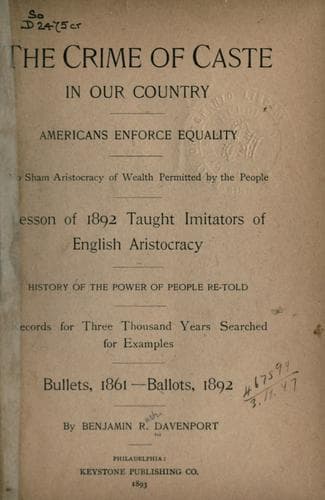
The Crime of Caste in Our CountryDavenport, Benjamin Rush
History
The Crime of Caste in Our Country
Davenport, Benjamin Rush
Social problems; United States -- Social conditions -- 1865-1918
“The nomination of Mr. Cleveland was dictated by the general
sentiment of the party, inspired wholly by confidence in his
integrity, purity, firmness, and sound sense. It was unaided by
any organization, promoted by no machine, advocated by no literary
bureau, appealed to no base passion. * * * * * * His election is
due to the recognition by hundreds of thousands of sound-hearted
American citizens, who had not before acted with the Democratic
party, that under his guidance, with its avowed policy, that
party was a fit depository of the powers of the Government. It
is, moreover, preëminently a victory of courage and fidelity to
principle. The Chicago Convention, in taking Mr. Cleveland as its
candidate, planted itself firmly on the ground of principle.”
It is perfectly plain to be seen that, from a source where the wreath
of victory dangles, inscribed with but one word, and that “Cleveland,”
one could hardly expect to find information as to the cause that
brought about this revolution in the minds of the people. Not that
there is any objection to the praises of Cleveland, because all that
they say of him is believed by thousands throughout the country, and
the same thing is believed to be true of thousands of other men whom
the Democratic party might have nominated. Horace Greeley, could he
have been taken from his tomb and reanimated, would just as surely
have been elected upon the Democratic ticket, had the people believed,
as they did, that that ticket represented that “caste,” moneyed
aristocracy, to which they were bitterly in their heart of hearts
opposed.
The New York _World_, controlled by one of the brightest, keenest, and
shrewdest of men in the journalistic field, in an excellent editorial
of November 10, 1892, proceeds to tell what the victory means. And one
sentence particularly would be significant, if followed by a little
definition of “plutocracy.” Were this word significant enough to cover
the objectionable features of the peculiar kind of “caste” which had
become identified with the Republican party, it would be sufficient,
but such is not the understanding of the word.
New York _World_, November 10th: “The President elect is the very
embodiment of conscientious caution. He is preëminently conservative.
His administration will mean economy, reform, retrenchment in every
branch of the Government. The victory does mean putting a stop to riot,
extravagance, profligacy, and corruption.”
Few, very few, men who voted the Democratic ticket believe that there
had been corruption, profligacy, under the Republican administration.
The people were not directly affected by the aforesaid charges. The
victory did not mean that.
Public-domain text, read in full here on John Shaqi.
Reviews
Reviews
No reviews yet
Be the first to share your thoughts on this work.
Join the Discussion
Join the discussion
Sign in to leave a comment or review.
Sign InorCreate an account