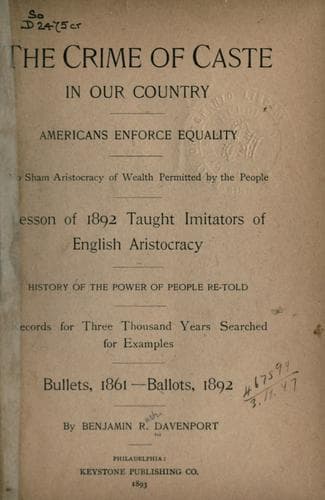
The Crime of Caste in Our CountryDavenport, Benjamin Rush
History
The Crime of Caste in Our Country
Davenport, Benjamin Rush
Social problems; United States -- Social conditions -- 1865-1918
The people are no longer political drones; they are thinking men, moved
by sentiments and forces which have not as yet been explained by the
most laborious newspaper articles written in the heat of the campaign,
actuated in many cases by partisan interests, party journalists,
aristocratic tendencies, and political affiliations. Each would see
only his side of the party shield, and that was sure to be golden.
Mr. Cleveland, in his speech at the Manhattan Club, New York,
commenting on this fact, states: “The American people have become
political, and more thoughtful, and more watchful than they were ten
years ago. They are considering now, vastly more than they were then,
political principles and party policies, in distinction from party
manipulation and distribution of rewards for political services and
activities.”
The reason for this is obvious. The country has been flooded of late
years with newspapers, brought down to a nominal price; the people
have read them thoughtfully; have written to them for explanations
of difficulties and doubts arising in their minds, and have profited
by these explanations. They have seen paraded in the newspapers the
exhibitions of the pride of “caste”; they have seen chronicled the
doings of the American Duchess with her divorced duke; they have
learned to hate that which the Republican party would have preached
to them as the source of all their happiness and prosperity. The
Republican party, viewing it only as a means whereby fortunes were
accumulated, espoused the principles which created a desire in the
minds of divorced dukes, puppified lords, and degenerate descendants of
English nobility, from cupidity, to marry America’s fair daughters. The
cheapness of the newspapers placed within the reach of the poorest the
information upon which he based his faith. The penny paper is the great
leveler of the land.
The New York _Herald_, of November 13th, commenting on the recent
election, takes a biblical text as its theme: “Then were the people of
Israel divided into two parts. Half of the people followed Tibni and
half followed Omri; but the people that followed Omri prevailed against
the people that followed Tibni: so Tibni died and Omri reigned,” and
says:--
Public-domain text, read in full here on John Shaqi.
Reviews
Reviews
No reviews yet
Be the first to share your thoughts on this work.
Join the Discussion
Join the discussion
Sign in to leave a comment or review.
Sign InorCreate an account