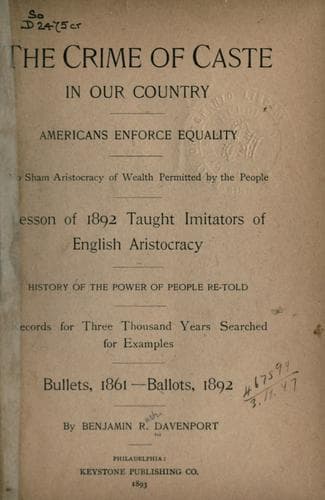
The Crime of Caste in Our CountryDavenport, Benjamin Rush
History
The Crime of Caste in Our Country
Davenport, Benjamin Rush
Social problems; United States -- Social conditions -- 1865-1918
It did not do for the Republican press of the country to demonstrate
that Protection brought higher wages to the workingman. They might
have proved that by voting the Republican ticket the workingman’s pay
would have been a hundred dollars a day; they might have shown him
that in point of pocket he would be eternally blest by supporting the
party which he deemed identified with those who attempted to force
“caste” upon our country. It is not a question of money; the equality
of man is the American’s birthright. For it, our fathers sought these
shores, contending with privation, enduring untold labor, dangers,
and death. For it, our forefathers fought the most powerful nation on
earth, when they were but a scattered handful of colonists, scattered
from Massachusetts to Georgia. When the attempt was made--that it was
attempted, there can be no doubt--to buy the American’s birthright by
preaching to him “increased wages,” it failed.
Take every speech of every Republican orator, every bit of Republican
literature, every editorial in the Republican papers, all speak from
but one text, viz.: “Workmen, farmers, in fact, all ye good people
of America, you can make more money under Protection;” which plainly
means, “Let Protection and the Republican party (which you designate in
your hearts as The Rich Man’s party) continue in power, accumulating
wealth, creating class distinctions, and you can have better wages.”
In other words, “Sell us the right to create a Republic like that of
Venice, wherein the rich became the privileged class, and we will give
you better pay.”
The Democratic press, orators, and literary bureau were no better.
They no more understood the feeling of the people, for their continual
cry was, “Free Trade, and you will be better off in pocket.” They
excoriated trusts, monopolies; they talked of corruption and what would
be done to benefit, IN POCKET, the poor man, if the Democratic party
came in power; just as blind as their brothers of the Republican party,
they appealed to the American pocketbook.
While every Democratic orator knew that he felt the sting of the
venomous and growing reptile, “caste,” in no place in the literature of
the Democratic party, in no paper, can be found one single reference
to the pride of the American in his citizenship, in his equality. It
seemed as if each man thought that he alone endured a pang upon the
subject of “caste” and social distinction; for, bear in mind, the man
with one million will feel the slight and attempted distinction between
his family and the family with ten millions, just as keenly as the
cashier of a bank will feel the distinction that the president attempts
to make between their social positions; the farmer with ten acres feels
towards the farmer with a hundred acres, exactly the same as the farmer
with a hundred does towards the farmer possessed of a thousand acres.
Public-domain text, read in full here on John Shaqi.
Reviews
Reviews
No reviews yet
Be the first to share your thoughts on this work.
Join the Discussion
Join the discussion
Sign in to leave a comment or review.
Sign InorCreate an account