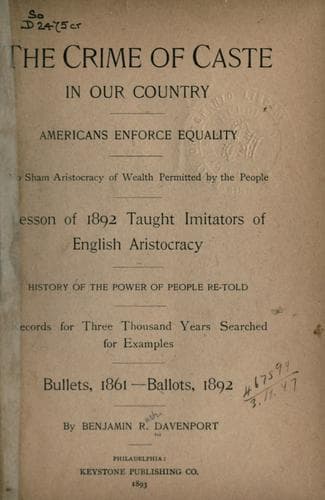
The Crime of Caste in Our CountryDavenport, Benjamin Rush
History
The Crime of Caste in Our Country
Davenport, Benjamin Rush
Social problems; United States -- Social conditions -- 1865-1918
This disease was not confined to the horny-handed sons of toil; the
heart in the hovel was not the only one that ached. It was not confined
to the follower of the plow; but its pestilential breath pervaded every
home in the land, leaving everyone below the multi-millionaire unhappy.
The clerk of the dry-goods store was hurt because the floor walker
assumed a superiority; the floor walker, because the proprietor assumed
it; the proprietor, because the importer from whom he purchased goods
assumed a distinction; and so it continued, from the longshoreman up,
until it reached our millionaire would-be princes, who ape and mimic
English life and manners, leaving, as it arose, a sting of increasing
bitterness; but each man felt too proud to give utterance to what he
thought it shamed him even to recognize as a sensation.
Hence the apathy on the surface, the sentiment confessed only to
themselves and in the closet of the voting booth. Because the people
had identified the Republican party with the class of men who were
striving to create this class distinction, and because of the very
charm of the word Democracy to their aching hearts, they voted the
Democratic ticket--not Democrats alone in a political sense, but men
who believe in democracy in the broad sense that St. Paul preached on
Mars Hill at Athens, in the broad sense that Christ’s life demonstrated.
It was useless, against this first overmastering, powerful emotion in
the American breast, to call upon the old veterans of the Civil War, to
whom the Republican party had given increased pensions. It was useless
to cry even to the negro, to whom the Republican party had given
freedom. He, too, had become imbued with the spirit of equality. The
wealthy could not purchase the birthright of the veteran by appealing
to his pocketbook, any more than they could that of the laborer.
He had shed his blood in the cause of equality, resisting then the
assumed superiority of blood and birth so often flaunted in his face by
gentlemen from the South.
In 1861, the “mudsills” of the North and West, the tillers of the soil,
had shouldered their muskets at the call of that great man of the
people, Abraham Lincoln, leaving home and loved ones to face unknown
dangers and diseases in the cause of EQUALITY. Down in their hearts
then was a sentiment which is revived in 1892. That thing which had
been the hardest to bear, for the laboring settler of the West and the
workman of the North, was the existence of “caste” in the South, and
the supposed superiority of the Southerners in the halls of Congress.
Love of the Union was the outspoken, pronounced cause of their coming
at Lincoln’s call; but there was something behind and beneath all of
that, that had been growing for years; it was resentment, because of
the South’s assumption of “caste” in our country.
Public-domain text, read in full here on John Shaqi.
Reviews
Reviews
No reviews yet
Be the first to share your thoughts on this work.
Join the Discussion
Join the discussion
Sign in to leave a comment or review.
Sign InorCreate an account