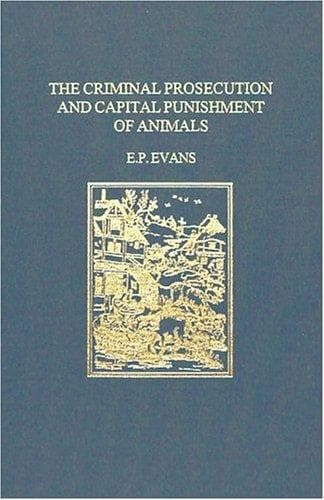
The Criminal Prosecution and Capital Punishment of Animals — John Shaqi
The Criminal Prosecution and Capital Punishment of AnimalsEvans, E. P. (Edward Payson)
History
The Criminal Prosecution and Capital Punishment of Animals
Evans, E. P. (Edward Payson)
Animals -- Law and legislation -- History; Animals, Prosecution and punishment of -- History; Trials -- Europe
It was also as a protection against evil spirits that the penalty of death
was inflicted upon domestic animals. A homicidal pig or bull was not
necessarily assumed to be the incarnation of a demon, although it was
maintained by eminent authorities, as we have shown in the present work,
that all beasts and birds, as well as creeping things, were devils in
disguise; but the homicide, if it were permitted to go unpunished, was
supposed to furnish occasion for the intervention of devils, who were
thereby enabled to take possession of both persons and places. This belief
was prevalent in the Middle Ages, and is still taught by the Catholic
Church. In a little volume entitled _Die Verwaltung des Exorcistats nach
Massgabe der römischen Benediktionale_, of which a revised and enlarged
edition was published at Stuttgart in 1893 for the use of priests as a
manual of instruction in performing exorcisms, it is expressly stated by
the reverend author, Dr. Theobald Bischofberger, that a spot, where a
murder or other heinous crime has been committed, if the said crime
remains undetected or unexpiated, is sure to be infested by demons, and
that the inmates of a house or other building erected upon such a site
will be peculiarly liable to diabolical possession, however innocent they
may be personally. Indeed, the more pure and pious they are, the greater
will be the efforts of the demons to enter into and annoy them. Not only
human beings, but also all cattle after their kind, and even the fowls of
the barnyard are subject to infernal vexations of this sort. The
infestation thus produced may continue for centuries, and, although the
property may pass by purchase or inheritance into other hands and be held
successively by any number of rightful owners, the demons remain in
possession unaffected by legal conveyances. If each proprietor imagines he
has an exclusive title to the estate, he reckons without the host of
devils, who exercise there the right of squatter sovereignty and can be
expelled only by sacerdotal authority. Dr. Bischofberger goes so far as to
affirm that it behoves the purchaser of a piece of land to make sure that
it is unencumbered by devils as well as by debts, otherwise he may have to
suffer more from a demoniac lien than from a dead pledge or any other form
of obligation in law. Information concerning the latter can be obtained at
the registry of deeds, but it is far more difficult to ascertain whether
the infernal powers have any claims upon it, since this knowledge can be
derived only inferentially and indirectly from inquiries into the
character of the proprietors for many generations and must always rest
upon presumptive evidence rather than positive proof. Our author does not
hesitate to assert that houses which have been the abodes of pious people
from time immemorial ought to have a higher market value than the
habitations of notoriously wicked families. It is thus shown that
Public-domain text, read in full here on John Shaqi.
Reviews
Reviews
No reviews yet
Be the first to share your thoughts on this work.
Join the Discussion
Join the discussion
Sign in to leave a comment or review.
Sign InorCreate an account