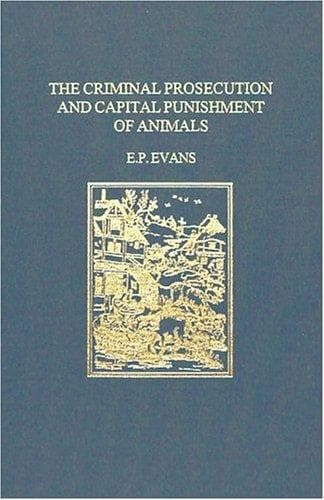
The Criminal Prosecution and Capital Punishment of AnimalsEvans, E. P. (Edward Payson)
History
The Criminal Prosecution and Capital Punishment of Animals
Evans, E. P. (Edward Payson)
Animals -- Law and legislation -- History; Animals, Prosecution and punishment of -- History; Trials -- Europe
At a later period of his life Chassenée was reminded of the legal
principle thus laid down and urged to apply it in favour of clients more
worthy of its protection than a horde of vagrant rodents. In 1540 he was
president of the judicial assembly known as the Parliament of Provence on
a memorable occasion when the iniquitous measure for the extirpation of
heresy by exterminating the Waldenses in the villages of Cabrières and
Merindol was under discussion. One of the members of the tribunal, a
gentleman from Arles, Renaud d’Alleins, ventured to suggest to the
presiding officer that it would be extremely unjust to condemn these
unfortunate heretics without granting them a hearing and permitting an
advocate to speak in their defence, so that they might be surrounded by
all the safeguards of justice, adding that the eminent jurist had formerly
insisted upon this right before the court of Autun and maintained that
even animals should not be adjudged and sentenced without having a proper
person appointed to plead their cause. Chassenée thereupon obtained a
decree from the king commanding that the accused Waldenses should be
heard; but his death, which occurred very soon afterwards, changed the
state of affairs and prevented whatever good effects might have been
produced by this simple act of justice. [Cf. Desnoyers: _Recherches_, etc.
(_vide_ Bibliography), p. 18.]
In the report of the trial published in the _Thémis Jurisconsulte_ for
1820 (Tome I. pp. 194 sqq.) by Berriat Saint-Prix, on the authority of the
celebrated Jacques Auguste De Thou, President of the Parliament of Paris,
the sentence pronounced by the official is not recorded. But whatever the
judicial decision may have been, the ingenuity and acumen with which
Chassenée conducted the defence, the legal learning which he brought to
bear upon the case, and the eloquence of his plea enlisted the public
interest and established his fame as a criminal lawyer and forensic
orator.
Public-domain text, read in full here on John Shaqi.
Reviews
Reviews
No reviews yet
Be the first to share your thoughts on this work.
Join the Discussion
Join the discussion
Sign in to leave a comment or review.
Sign InorCreate an account