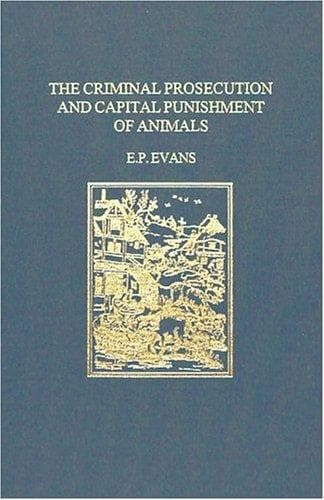
The Criminal Prosecution and Capital Punishment of Animals — John Shaqi
The Criminal Prosecution and Capital Punishment of AnimalsEvans, E. P. (Edward Payson)
History
The Criminal Prosecution and Capital Punishment of Animals
Evans, E. P. (Edward Payson)
Animals -- Law and legislation -- History; Animals, Prosecution and punishment of -- History; Trials -- Europe
Chassenée is said to have been employed in several cases of this kind, but
no records of them seem to have been preserved, although it is possible
that they may lie buried in the dusty archives of some obscure provincial
town in France, once the seat of an ecclesiastical tribunal. The whole
subject, however, has been treated by him exhaustively in a book entitled
_Consilium primum, quod tractatus jure dici potest, propter multiplicem et
reconditam doctrinam, ubi luculenter et accurate tractatur quaestio illa:
De excommunicatione animalium insectorum_. This treatise, which is the
first of sixty-nine consilia, embodying opinions on various legal
questions touching the holding and transmission of property, entail,
loans, contracts, dowries, wills, and kindred topics, and which holds a
peculiar place in the history of jurisprudence, was originally published
in 1531, and reprinted in 1581, and again in 1588. The edition referred to
in the present work is the first reprint of 1581, a copy of which is in
the Royal Court and State Library of Munich.
This curious dissertation originated, as it appears, in an application of
the inhabitants of Beaune to the ecclesiastical tribunal of Autun for a
decree of excommunication against certain noxious insects called huberes
or hurebers, probably a kind of locust or harvest-fly. The request was
granted, and the pernicious creatures were duly accursed. Chassenée now
raises the query whether such a thing may be rightfully and lawfully done
(_sed an recte et de jure fieri possit_), and how it should be effected.
“The principal question,” he says, “is whether one can by injunction cause
such insects to withdraw from a place in which they are doing damage, or
to abstain from doing damage there, under penalty of anathema and
perpetual malediction. And although in times past there has never been any
doubt on this point, yet I have thought that the subject should be
thoroughly examined anew, lest I should seem to fall into the vice
censured by Cicero (_De Off._ I. 6), of regarding things which we do not
know as if they were well understood by us, and therefore rashly giving
them our assent.” He divides his treatise into five parts, or rather
discusses the subject under five heads: “First, lest I may seem to
discourse to the populace, how are these our animals called in the Latin
language; secondly, whether these our animals can be summoned; thirdly,
whether they can be summoned by procurators, and, if they are cited to
appear personally, whether they can appear by proxy, _i.e._ through
procurators appointed by the judge who summons them; fourthly, what
judge, whether layman or ecclesiastic, is competent to try them, and how
he is to proceed against them and to pass and execute sentence upon them;
fifthly, what constitutes an anathema and how does it differ from an
excommunication.” Chassenée’s method of investigation is not that of the
philosophic thinker, who marshals facts under general laws and traces them
Public-domain text, read in full here on John Shaqi.
Reviews
Reviews
No reviews yet
Be the first to share your thoughts on this work.
Join the Discussion
Join the discussion
Sign in to leave a comment or review.
Sign InorCreate an account