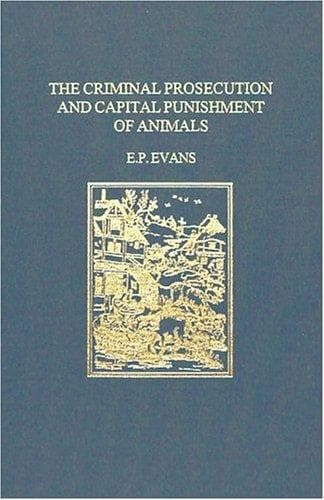
The Criminal Prosecution and Capital Punishment of Animals — John Shaqi
The Criminal Prosecution and Capital Punishment of AnimalsEvans, E. P. (Edward Payson)
History
The Criminal Prosecution and Capital Punishment of Animals
Evans, E. P. (Edward Payson)
Animals -- Law and legislation -- History; Animals, Prosecution and punishment of -- History; Trials -- Europe
But to return to the records of the trial. On the 13th of April, 1587, the
case was laid before “his most reverend lordship, the prince-bishop of
Maurienne, or the reverend lord his vicar-general and official” by the
syndics and procurators, François Amenet and Petremand Bertrand, who, in
the name of the inhabitants of St. Julien, presented the following
statement and petition: “Formerly by virtue of divine services and
earnest supplications the scourge and inordinate fury of the aforesaid
animals did cease; now they have resumed their depredations and are doing
incalculable injury. If the sins of men are the cause of this evil, it
behoveth the representatives of Christ on earth to prescribe such measures
as may be appropriate to appease the divine wrath. Wherefore we the
afore-mentioned syndics, François Amenet and Petremand Bertrand, do appear
anew (_ex integro_) and beseech the official, first, to appoint another
procurator and advocate for the insects in place of the deceased Pierre
Falcon and Claude Morel, and secondly, to visit the grounds and observe
the damage, and then to proceed with the excommunication.”
In compliance with this request, the distinguished Antoine Filliol was
appointed procurator for the insects, with a moderate fee (_salario
moderato_), and Pierre Rembaud their advocate. The parties appeared before
the official on the 30th day of May and the case was adjourned to the 6th
of June, when the advocate, Pierre Rembaud, presented his answer to the
declaration of the plaintiffs, showing that their action is not
maintainable and that they should be nonsuited. After approving of the
course pursued by his predecessor in office, he affirms that his clients
have kept within their right and not rendered themselves liable to
excommunication, since, as we read in the sacred book of Genesis, the
lower animals were created before man, and God said to them: Let the earth
bring forth the living creature after his kind, cattle and creeping thing,
and beast of the earth after his kind; and he blessed them saying, Be
fruitful and multiply and fill the waters of the seas, and let fowl
multiply in the earth. Now the Creator would not have given this command,
had he not intended that these creatures should have suitable and
sufficient means of support; indeed, he has expressly stated that to every
thing that creepeth upon the earth every green herb has been given for
meat. It is therefore evident that the accused, in taking up their abode
in the vines of the plaintiffs, are only exercising a legitimate right
conferred upon them at the time of their creation. Furthermore, it is
absurd and unreasonable to invoke the power of civil and canonical law
against brute beasts, which are subject only to natural law and the
impulses of instinct. The argument urged by the counsel for the
plaintiffs, that the lower animals are made subject to man, he dismisses
as neither true in fact nor pertinent to the present case. He suggests
Public-domain text, read in full here on John Shaqi.
Reviews
Reviews
No reviews yet
Be the first to share your thoughts on this work.
Join the Discussion
Join the discussion
Sign in to leave a comment or review.
Sign InorCreate an account