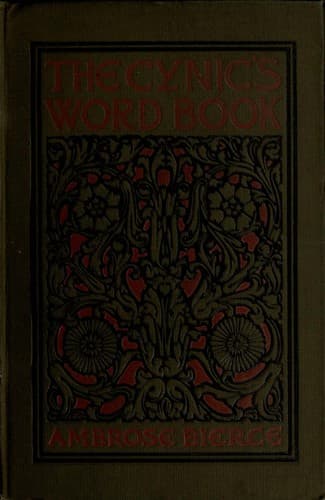
English language -- Dictionaries -- Humor; English language -- Semantics -- Humor; Vocabulary -- Humor
HABIT, n. A shackle for the free.
HADES, n. The lower world; the residence of departed spirits; the place
where the dead live.
Among the ancients the idea of Hades was not synonymous with our Hell,
many of the most respectable men of antiquity residing there in a very
comfortable kind of way. Indeed, the Elysian Fields themselves were a
part of Hades, though they have since been removed to Paris. When the
Jacobean version of the New Testament was in process of evolution the
pious and learned men engaged in the work insisted by a majority vote
on translating the Greek word "Hades" as "Hell"; but a conscientious
minority member secretly possessed himself of the record and struck out
the objectionable word wherever he could find it. At the next meeting,
the Bishop of Winchester, looking over the work, suddenly sprang to his
feet and said with considerable excitement: "Gentlemen, somebody has
been razing 'Hell' here!" Years afterwards the good prelate's death
was made sweet by the reflection that he had been the means (under
Providence) of making an important, serviceable, and immortal addition
to the phraseology of the English tongue.
HAG, n. An elderly lady whom you do not happen to like; sometimes
called, also, a hen, or cat. Old witches, sorceresses, etc., were called
hags from the belief that their heads were surrounded by a kind of
baleful lumination or nimbus--hag being the popular name of that peculiar
electrical light sometimes observed in the hair. At one time hag was
not a word of reproach: Drayton speaks of a "beautiful hag, all smiles,"
much as Shakespeare said, "sweet wench." It would not now be proper
to call your sweetheart a hag--that pleasure is reserved for her
grandchildren.
HALF, n. One of two equal parts into which a thing may be divided, or
considered as divided. In the fourteenth century a heated discussion
arose among the theologists and philosophers as to whether Omniscience
could part an object into three halves; and the pious Father Aldrovinus
publicly prayed in the cathedral at Rouen that God would demonstrate the
affirmative of the proposition in some signal and unmistakable way,
and particularly (if it should please Him) upon the body of that hardy
blasphemer, Manutius Procinus, who maintained the negative. Procinus,
however, was spared to die of the bite of a viper.
Public-domain text, read in full here on John Shaqi.
Reviews
Reviews
No reviews yet
Be the first to share your thoughts on this work.
Join the Discussion
Join the discussion
Sign in to leave a comment or review.
Sign InorCreate an account