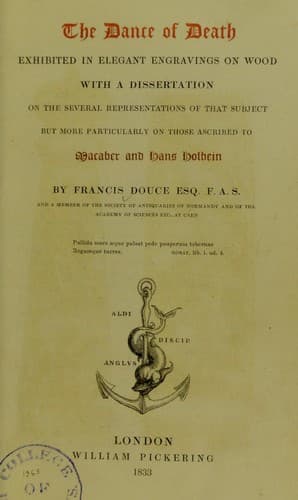
The Dance of Death: Exhibited in Elegant Engravings on Wood with a Dissertation on the Several Representations of that Subject but More Particularly on Those Ascribed to Macaber and Hans HolbeinDouce, Francis
History
The Dance of Death: Exhibited in Elegant Engravings on Wood with a Dissertation on the Several Representations of that Subject but More Particularly on Those Ascribed to Macaber and Hans Holbein
Douce, Francis
Bible. Old Testament -- Illustrations; Dance of death
Misson has noticed a Dance of Death in St. Mary's church at Berlin, and
obscurely referred to another in some church at Nuremberg.
Bruckmann, in his Epistolæ Itinerariæ, vol. v. Epist. xxxii. describes
several churches and other religious buildings at Vienna, and among them
the monastery of the Augustinians, where, he says, there is a painting of
a house with Death entering one of the windows by a ladder.
In the same letter he describes a chapel of Death in the above monastery,
which had been decorated with moral paintings by Father Abraham à St.
Clara, one of the monks. Among these were, 1. Death demolishing a student.
2. Death attacking a hunter who had just killed a stag. 3. Death in an
apothecary's shop, breaking the phials and medicine boxes. 4. Death
playing at draughts with a nobleman. 5. Harlequin making grimaces at
Death. A description of this chapel, and its painting was published after
the good father's decease. Nuremberg, 1710, 8vo.
The only specimen of it in Holland that has occurred on the present
occasion is in the celebrated _Orange-Salle_, which constitutes the grand
apartment of the country seat belonging to the Prince of Orange in the
wood adjacent to the Hague. In three of its compartments, Death is
represented by skeletons darting their arrows against a host of
opponents.[76]
Nor has Italy furnished any materials for the present essay. Blainville
has, indeed, described a singular and whimsical representation of Death in
the church of St. Peter the Martyr, at Naples, in the following words. "At
the entrance on the left is a marble with a representation of Death in a
grotesque form. He has two crowns on his head, with a hawk on his fist, as
ready for hunting. Under his feet are extended a great number of persons
of both sexes and of every age. He addresses them in these lines:
Eo sò la morte che caccio
Sopera voi jente mondana,
La malata e la sana,
Di, e notte la percaccio;
Non fugge, vessuna intana
Per scampare dal mio laczio
Che tutto il mondo abbraczio,
E tutta la jente humana
Perchè nessuno se conforta,
Ma prenda spavento
Ch'eo per comandamento
Di prender à chi viene la sorte.
Sia vi per gastigamento
Questa figura di morte,
E pensa vie di fare forte
Tu via di salvamento.
Opposite to the figure of Death is that of a man dressed like a tradesman
or merchant, who throws a bag of money on a table, and speaks thus:
Tutti ti volio dare
Se mi lasci scampare.
To which Death answers:
Se mi potesti dare
Quanto si pote dimandare
Non te pote scampare la morte
Se te viene la sorte.[77]
Public-domain text, read in full here on John Shaqi.
Reviews
Reviews
No reviews yet
Be the first to share your thoughts on this work.
Join the Discussion
Join the discussion
Sign in to leave a comment or review.
Sign InorCreate an account