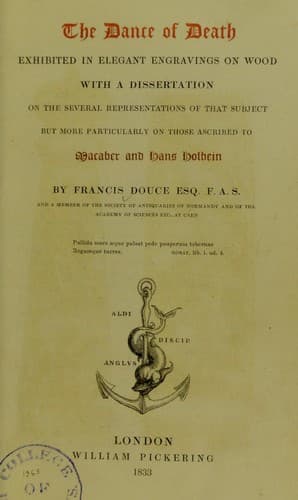
The Dance of Death: Exhibited in Elegant Engravings on Wood with a Dissertation on the Several Representations of that Subject but More Particularly on Those Ascribed to Macaber and Hans HolbeinDouce, Francis
History
The Dance of Death: Exhibited in Elegant Engravings on Wood with a Dissertation on the Several Representations of that Subject but More Particularly on Those Ascribed to Macaber and Hans Holbein
Douce, Francis
Bible. Old Testament -- Illustrations; Dance of death
The circumstances that lead to Death, and not our actual dissolution, are
alone of a terrific nature; for Death is, in fact, the end and cure of all
the previous sufferings and horrors with which it is so frequently
accompanied. In the dark ages of monkish bigotry and superstition, the
deluded people, seduced into a belief that the fear of Death was
acceptable to the great and beneficent author of their existence, appear
to have derived one of their principal gratifications in contemplating
this necessary termination of humanity, yet amidst ideas and impressions
of the most horrible and disgusting nature: hence the frequent allusions
to it, in all possible ways, among their preachers, and the
personification of it in their books of religious offices, as well as in
the paintings and sculptures of their ecclesiastical and other edifices.
They seemed to have entirely banished from their recollection the
consolatory doctrines of the Gospel, which contribute so essentially to
dissipate the terrors of Death, and which enable the more enlightened
Christian to abide that event with the most perfect tranquillity of mind.
There are, indeed, some exceptions to this remark, for we may still trace
the imbecility of former ages on too many of our sepulchral monuments,
which are occasionally tricked out with the silly appendages of Death's
heads, bones, and other useless remains of mortality, equally repulsive to
the imagination and to the elegance of art.
If it be necessary on any occasion to personify Death, this were surely
better accomplished by means of some graceful and impressive figure of the
Angel of Death, for whom we have the authority of Scripture; and such
might become an established representative. The skulls and bones of
modern, and the entire skeletons of former times, especially during the
middle ages, had, probably, derived their origin from the vast quantities
of sanctified human relics that were continually before the eyes, or
otherwise in the recollection of the early Christians. But the favourite
and principal emblem of mortality among our ancestors appears to have been
the moral and allegorical pageant familiarly known by the appellation of
the _Dance of Death_, which it has, in part, derived from the grotesque,
and often ludicrous attitudes of the figures that composed it, and
especially from the active and sarcastical mockery of the ruthless tyrant
upon its victims, which may be, in a great measure, attributed to the
whims and notions of the artists who were employed to represent the
subject.
Public-domain text, read in full here on John Shaqi.
Reviews
Reviews
No reviews yet
Be the first to share your thoughts on this work.
Join the Discussion
Join the discussion
Sign in to leave a comment or review.
Sign InorCreate an account