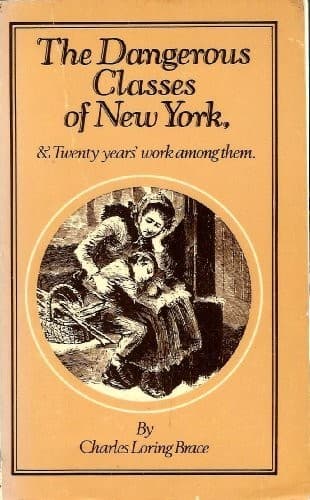
The Dangerous Classes of New York, and Twenty Years' Work Among Them — John Shaqi
The Dangerous Classes of New York, and Twenty Years' Work Among ThemBrace, Charles Loring
History
The Dangerous Classes of New York, and Twenty Years' Work Among Them
Brace, Charles Loring
Child welfare -- New York (State) -- New York; New York (N.Y.) -- Social conditions; Poor -- New York (State) -- New York
When one thinks what was the fate before He lived, throughout the
civilized world, of for instance one large and pitiable class of human
beings--unfortunate children, destitute orphans, foundlings, the
deformed and sickly, and female children of the poor; how almost
universal, even under the highest pagan civilization--the Greek and
Roman--infanticide was; how Plato and Aristotle both approved of it; how
even more common was the dreadful exposure of children who were
physically imperfect or for any cause disagreeable to their parents, so
that crowds of these little unfortunates were to be seen exposed around
a column near the Velabrum at Rome--some being taken to be raised as
slaves, others as prostitutes, others carried off by beggars and maimed
for exhibition, or captured by witches to be murdered, and their bodies
used in their magical preparations; when one remembers for how many
centuries, even after the nominal introduction of Christianity, the sale
of free children was permitted by law, and then recalls how utterly the
spirit of the Founder of Christianity has exterminated these barbarous
practices from the civilized world; what vast and ingenious charities
exist in every Christian country for this unfortunate class; what time
and wealth and thought are bestowed to heal the diseases, purify the
morals, raise the character, and make happy the life of foundlings,
outcast girls and boys and orphans, we can easily understand that the
source of the charities of civilized nations has been especially in
Christ; and knowing how vital the moral care of unfortunate children is
to civilization itself the most skeptical among us may still put Him at
the head of even modern social reform.
EXPOSURE OF CHILDREN.
The "exposure of children" is spoken of casually and with indifference
by numerous Latin authors. The comedians include the custom in their
pictures of the daily Roman life, usually without even a passing
condemnation. Thus, in Terence's play (Heauton: Act iii., sc. v.), the
very character who uttered the apothegm which has become a proverb of
humanity for all ages--"I am a man, and nothing belonging to man is
alien to me"--is represented, on the eve of his departure on a long
journey, as urging his wife to destroy the infant soon to be born, if it
should prove to be a girl, rather than expose it. She, however, exposes
it, and it was taken, as was usual, and brought up as a prostitute. This
play turns in its plot, as is true of many popular comedies, on this
exposition of the abandoned child.
It is frequently commented on by Roman dramatists, and subsequently by
the early Christian preachers, that, owing to this terrible custom,
brothers might marry sisters, or fathers share in the ruin of their
unknown daughters in houses of crime.
Public-domain text, read in full here on John Shaqi.
Reviews
Reviews
No reviews yet
Be the first to share your thoughts on this work.
Join the Discussion
Join the discussion
Sign in to leave a comment or review.
Sign InorCreate an account