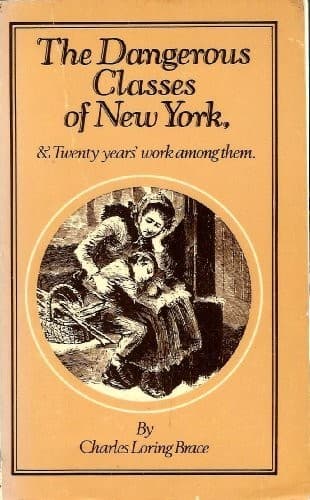
The Dangerous Classes of New York, and Twenty Years' Work Among ThemBrace, Charles Loring
History
The Dangerous Classes of New York, and Twenty Years' Work Among Them
Brace, Charles Loring
Child welfare -- New York (State) -- New York; New York (N.Y.) -- Social conditions; Poor -- New York (State) -- New York
Seneca, who certainly always writes with propriety and aims to be
governed by reason, in his treatise on Anger (De Ira: i., 15), comments
thus calmly on the practice: "Portentos foetus extingnimus; liberos
quoque si debiles, monstrosique editi sunt, mergimus. Non ira, sed
_ratio_ est, a sanis, inutilia secernere." (Monstrous offspring we
destroy; children too, if weak and unnaturally formed from birth, we
drown. It is not anger, but reason, thus to separate the useless from
the sound.)
In another work (Controversi, lib. v., 33), he denounces the horrible
practice, common in Rome, of maiming these unfortunate children and then
offering them to the gaze of the compassionate. He describes the
miserable little creatures with shortened limbs, broken Joints, and
carved backs, exhibited by the villainous beggars who had gathered them
at the _Lactaria,_ and then deformed them: "Volo nosse," "I should like
to know" says the moralist, with a burst of human indignation, "illam
calamitatum humanarum officinam--illud infantum spoliarium!"--"that
workshop of human misfortunes--those shambles of infants!"
On the day that Germanicus died, says Suetonius (in Calig., n. 5),
"Subversae Deam arae, partus conjugum expositi," parents exposed their
new-born babes.
The early Christian preachers and writers were unceasing in their
denunciations of the practice.
Quintilian (Decl. 306, vol vi., p. 236) draws a most moving picture of
the fate of these unhappy children left in the Forum: "Rarum est ut
expositi vivant! Yos ponite ante oculos puerum statim neglectum * * *
inter feras et volucres."
"It is rare that the exposed survive!" he says.
Tertullian, in an eloquent passage (Apol., c. 9), asks: "Quot vultis ex
his circumstantibus et in christianum sanguinem hiantibus * * * apud
conscientias pulsem, qui natos sibi liberos enecent?"
"How many, do you suppose, of those standing about and panting for the
blood of Christians, if I should put it to them before their very
conscience, would deny that they killed their own children?"
Lactantius, who was the tutor of the son of Constantine, in a book
dedicated to Constantine, protests: "It is impossible to grant that one
has the right to strangle one's new-born children"; and speaks of
exposition as exposing one's own blood--"ad servitutem vel ad
lupanar"--"for slavery or the brothel." "It is a crime as execrable to
expose a child as to kill him."
So fearfully did the numbers increase, under the Roman Empire, of these
unfortunate children, that the spark of charity, which is never utterly
extinguished in the human breast, began to kindle. Pliny the Younger is
said to have appropriated a sum equivalent to $52,000 (see Epist., v.,
7), to found an asylum for fathers unable to support their children.
THE FIRST CHILDREN'S ASYLUM.
Public-domain text, read in full here on John Shaqi.
Reviews
Reviews
No reviews yet
Be the first to share your thoughts on this work.
Join the Discussion
Join the discussion
Sign in to leave a comment or review.
Sign InorCreate an account