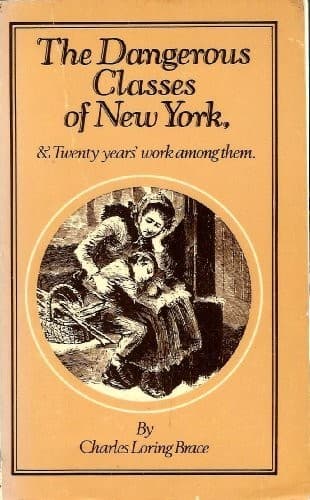
The Dangerous Classes of New York, and Twenty Years' Work Among Them — John Shaqi
The Dangerous Classes of New York, and Twenty Years' Work Among ThemBrace, Charles Loring
History
The Dangerous Classes of New York, and Twenty Years' Work Among Them
Brace, Charles Loring
Child welfare -- New York (State) -- New York; New York (N.Y.) -- Social conditions; Poor -- New York (State) -- New York
The causes of this encouraging state of things are not obscure. The
action of the great law of "Natural Selection," in regard to the human
race, is always towards temperance and virtue. That is, vice and extreme
indulgence weaken the physical powers and undermine the constitution;
they impair the faculties by which man struggles with adverse conditions
and gets beyond the reach of poverty and want. The vicious and sensual
and drunken die earlier, or they have fewer children, or their children
are carried off by diseases more frequently, or they themselves are
unable to resist or prevent poverty and suffering. As a consequence, in
the lowest class, the more self-controlled and virtuous tend constantly
to survive, and to prevail in "the struggle for existence," over the
vicious and ungoverned, and to transmit their progeny. The natural drift
among the poor is towards virtue. Probably no vicious organization with
very extreme and abnormal tendencies is transmitted beyond the fourth
generation; it ends in insanity or cretinism or the wildest crime.
The result is then, with the worst-endowed families, that the "gemmules"
or latent forces of hundreds of virtuous, or at least, not vicious,
generations, lie hid in their constitutions. The immediate influences of
parents or grandparents are, of course, the strongest latent tendencies
to good, coming down from remote ancestors, be aroused and developed.
Thus is explained the extraordinary improvement of the children of crime
and poverty in our Industrial Schools; and the reforms and happy change
is seen in the boys and girls of our dangerous classes when placed in
kind Western homes. The change of circumstances, the improved food, the
daily moral and mental influences, the effect of regular labor and
discipline, and, above all, the power of Religion, awaken these hidden
tendencies to good, both those coming from many generations of
comparative virtue and those inherent in the soul, while they control
and weaken and cause to be forgotten those diseased appetites or extreme
passions which these unfortunate creatures inherit directly, and
substitute a higher moral sense for the low moral instincts which they
obtained from their parents. So it happens, also, that American life, as
compared with European, and city life, as compared with country,
produces similar results. In the United States, a boundless hope
pervades all classes; it reaches down to the outcast and vagrant. There
is no fixity, as is so often the fact in Europe, from the sense of
despair. Every individual, at least till he is old, hopes and expects to
rise out of his condition.
Public-domain text, read in full here on John Shaqi.
Reviews
Reviews
No reviews yet
Be the first to share your thoughts on this work.
Join the Discussion
Join the discussion
Sign in to leave a comment or review.
Sign InorCreate an account