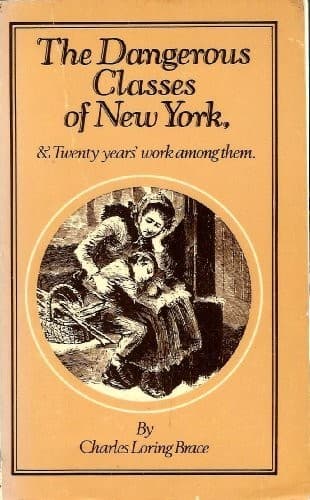
The Dangerous Classes of New York, and Twenty Years' Work Among ThemBrace, Charles Loring
History
The Dangerous Classes of New York, and Twenty Years' Work Among Them
Brace, Charles Loring
Child welfare -- New York (State) -- New York; New York (N.Y.) -- Social conditions; Poor -- New York (State) -- New York
The daughter of the rag-picker or vagrant sees the children she knows,
continually dressing better or associating with more decent people; she
beholds them attending the public schools and improving in education and
manners; she comes in contact with the greatest force the poor
know--public opinion, which requires a certain decency and
respectability among themselves. She becomes ashamed of her squalid,
ragged, or drunken mother. She enters an Industrial School, or creeps
into a Ward School, or "goes out" as a servant. In every place, she
feels the profound forces of American life; the desire of equality,
ambition to rise, the sense of self-respect and the passion for
education.
These new desires overcome the low appetites in her blood, and she
continually rises and improves. If Religion in any form reach her, she
attains a still greater height over the sensual and filthy ways of her
parents. She is in no danger of sexual degradation, or of any extreme
vice. The poison in her blood has found an antidote. When she marries,
it will inevitably be with a class above her own. This process goes on
continually throughout the country, and breaks up criminal inheritance.
Moreover, the incessant change of our people, especially in cities, the
separation of children from parents, of brothers from sisters, and of
all from their former localities, destroy that continuity of influence
which bad parents and grandparents exert, and do away with those
neighborhoods of crime and pauperism where vice concentrates and
transmits itself with ever-increasing power. The fact that tenants must
forever be "moving" in New York, is a preventive of some of the worst
evils among the lower poor. The mill of American life, which grinds up
so many delicate and fragile things, has its uses, when it is turned on
the vicious fragments of the lower strata of society.
Villages, which are more stable and conservative, and tend to keep
families together more and in the same neighborhoods, show more
instances of inherited and concentrated wickedness and idleness. In New
York the families are constantly broken up; some members improve, some
die out, but they do not transmit a progeny of crime. There is little
inherited criminality and pauperism.
A QUESTION.
Among these public influences on the young, it has been often a question
with some, whether the Public Schools did not educate the daughters of
the poor too much, and thus make them discontented with their condition,
and exposed to temptation.
Public-domain text, read in full here on John Shaqi.
Reviews
Reviews
No reviews yet
Be the first to share your thoughts on this work.
Join the Discussion
Join the discussion
Sign in to leave a comment or review.
Sign InorCreate an account