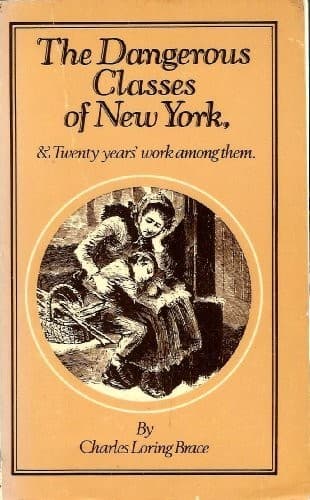
The Dangerous Classes of New York, and Twenty Years' Work Among ThemBrace, Charles Loring
History
The Dangerous Classes of New York, and Twenty Years' Work Among Them
Brace, Charles Loring
Child welfare -- New York (State) -- New York; New York (N.Y.) -- Social conditions; Poor -- New York (State) -- New York
The source of juvenile crime and misery in New York, which is the most
formidable, and, at the same time, one of the most difficult to remove,
is the _overcrowding_ of our population. The form of the city-site is
such--the majority of the dwellings being crowded into a narrow island
between two water-fronts--that space near the business-portion of the
city becomes of great value. These districts are necessarily sought for
by the laboring and mechanic classes, as they are near the places of
employment. They are avoided by the wealthy on account of the population
which has already occupied so much of them. The result is, that the poor
must live in certain wards; and as space is costly, the landlords supply
them with (comparatively) cheap dwellings, by building very high and
large houses, in which great numbers of people rent only rooms, instead
of dwellings.
Were New York a city radiating from a centre over an almost unlimited
space--as Philadelphia, for instance--the laborers or the mechanics
might take up their abode anywhere, and land would be comparatively
cheap, so that the highest blessing of the laboring class would be
attainable--of separate homes for each family. But, on this narrow
island, business is so peculiarly concentrated, and population is so
much forced to one exit--towards the north--and the poor have such a
singular objection to living beyond a ferry, that space will inevitably
continue very dear in New York, and the laboring classes will be
compelled to occupy it.
To add to the unavoidable costliness of ground-room on this island, has
come in the effect of bad government.
It is one of the most unpleasant experiences of the student of political
economy, that the axioms of his science can so seldom be understood by
the masses, though their interests be vitally affected by them. Thus,
every thoughtful man knows that each new "job" among city officials,
each act of plunder of public property by members of the municipal
government, every loss of income or mal-appropriation or extravagance in
the city's funds, must be paid for by taxation, and that taxation always
falls heaviest on labor. The laboring classes of the city rule it, and
through their especial leaders are the great public losses and
wastefulness occasioned.
Yet they never know that they themselves continually pay for these in
increased rents. Every landlord charges his advanced taxation in rent,
and probably a profit on that. The tenant pays more for his room, the
grocer more for his shop, the butcher and tailor and shoemaker, and
every retailer have heavier expenses from the advance in rents, and each
and all charge it on their customers. The poor feel the final pressure.
The painful effect has been, that the expense for rent has arisen
enormously with the laboring classes of this city during the last five
years, while many of the other living expenses have nearly returned to
the standard before the war.
Public-domain text, read in full here on John Shaqi.
Reviews
Reviews
No reviews yet
Be the first to share your thoughts on this work.
Join the Discussion
Join the discussion
Sign in to leave a comment or review.
Sign InorCreate an account