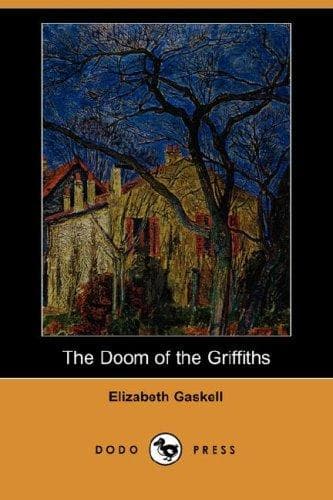
The Doom of the GriffithsGaskell, Elizabeth Cleghorn
General
The Doom of the Griffiths
Gaskell, Elizabeth Cleghorn
England -- Social life and customs -- 19th century -- Fiction; Horror tales, English
Here he hurriedly began to select the few articles he intended to take;
for, besides the dread of interruption, he was feverishly anxious to
travel far that very night, if only Nest was capable of performing the
journey. As he was thus employed, he tried to conjecture what his
father’s feelings would be on finding that his once-loved son was gone
away for ever. Would he then awaken to regret for the conduct which had
driven him from home, and bitterly think on the loving and caressing boy
who haunted his footsteps in former days? Or, alas! would he only feel
that an obstacle to his daily happiness—to his contentment with his wife,
and his strange, doting affection for the child—was taken away? Would
they make merry over the heir’s departure? Then he thought of Nest—the
young childless mother, whose heart had not yet realized her fulness of
desolation. Poor Nest! so loving as she was, so devoted to her child—how
should he console her? He pictured her away in a strange land, pining
for her native mountains, and refusing to be comforted because her child
was not.
Even this thought of the home-sickness that might possibly beset Nest
hardly made him hesitate in his determination; so strongly had the idea
taken possession of him that only by putting miles and leagues between
him and his father could he avert the doom which seemed blending itself
with the very purposes of his life as long as he stayed in proximity with
the slayer of his child.
He had now nearly completed his hasty work of preparation, and was full
of tender thoughts of his wife, when the door opened, and the elfish
Robert peered in, in search of some of his brother’s possessions. On
seeing Owen he hesitated, but then came boldly forward, and laid his hand
on Owen’s arm, saying,
“Nesta yr buten! How is Nest yr buten?”
He looked maliciously into Owen’s face to mark the effect of his words,
but was terrified at the expression he read there. He started off and
ran to the door, while Owen tried to check himself, saying continually,
“He is but a child. He does not understand the meaning of what he says.
He is but a child!” Still Robert, now in fancied security, kept calling
out his insulting words, and Owen’s hand was on his gun, grasping it as
if to restrain his rising fury.
But when Robert passed on daringly to mocking words relating to the poor
dead child, Owen could bear it no longer; and before the boy was well
aware, Owen was fiercely holding him in an iron clasp with one hand,
while he struck him hard with the other.
In a minute he checked himself. He paused, relaxed his grasp, and, to
his horror, he saw Robert sink to the ground; in fact, the lad was
half-stunned, half-frightened, and thought it best to assume
insensibility.
Owen—miserable Owen—seeing him lie there prostrate, was bitterly
repentant, and would have dragged him to the carved settle, and done all
he could to restore him to his senses, but at this instant the Squire
came in.
Public-domain text, read in full here on John Shaqi.
Reviews
Reviews
No reviews yet
Be the first to share your thoughts on this work.
Join the Discussion
Join the discussion
Sign in to leave a comment or review.
Sign InorCreate an account