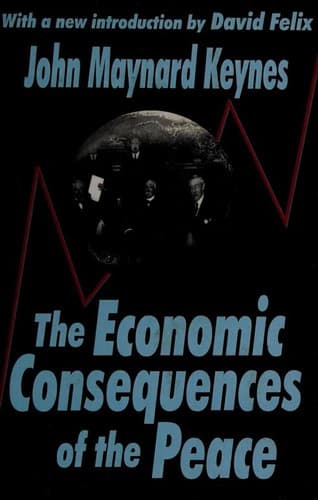
The Economic Consequences of the Peace — John Shaqi
The Economic Consequences of the PeaceKeynes, John Maynard
History
The Economic Consequences of the Peace
Keynes, John Maynard
Economic history -- 1918-1945; Treaty of Versailles (1919 June 28); World War, 1914-1918 -- Economic aspects
The statistics of the economic interdependence of Germany and her
neighbors are overwhelming. Germany was the best customer of Russia,
Norway, Holland, Belgium, Switzerland, Italy, and Austria-Hungary; she
was the second best customer of Great Britain, Sweden, and Denmark; and
the third best customer of France. She was the largest source of supply
to Russia, Norway, Sweden, Denmark, Holland, Switzerland, Italy,
Austria-Hungary, Roumania, and Bulgaria; and the second largest source
of supply to Great Britain, Belgium, and France.
In our own case we sent more exports to Germany than to any other
country in the world except India, and we bought more from her than from
any other country in the world except the United States.
There was no European country except those west of Germany which did not
do more than a quarter of their total trade with her; and in the case of
Russia, Austria-Hungary, and Holland the proportion was far greater.
Germany not only furnished these countries with trade, but, in the case
of some of them, supplied a great part of the capital needed for their
own development. Of Germany's pre-war foreign investments, amounting in
all to about $6,250,000,000, not far short of $2,500,000,000 was
invested in Russia, Austria-Hungary, Bulgaria, Roumania, and Turkey.[4]
And by the system of "peaceful penetration" she gave these countries not
only capital, but, what they needed hardly less, organization. The whole
of Europe east of the Rhine thus fell into the German industrial orbit,
and its economic life was adjusted accordingly.
But these internal factors would not have been sufficient to enable the
population to support itself without the co-operation of external
factors also and of certain general dispositions common to the whole of
Europe. Many of the circumstances already treated were true of Europe as
a whole, and were not peculiar to the Central Empires. But all of what
follows was common to the whole European system.
III. _The Psychology of Society_
Public-domain text, read in full here on John Shaqi.
Reviews
Reviews
No reviews yet
Be the first to share your thoughts on this work.
Join the Discussion
Join the discussion
Sign in to leave a comment or review.
Sign InorCreate an account