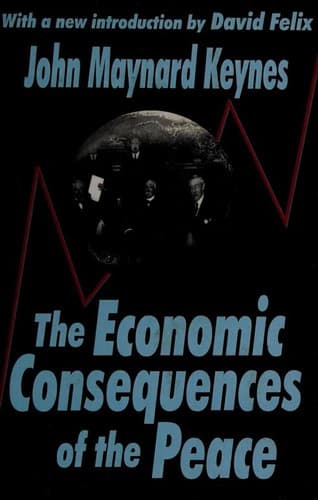
The Economic Consequences of the Peace — John Shaqi
The Economic Consequences of the PeaceKeynes, John Maynard
History
The Economic Consequences of the Peace
Keynes, John Maynard
Economic history -- 1918-1945; Treaty of Versailles (1919 June 28); World War, 1914-1918 -- Economic aspects
Europe was so organized socially and economically as to secure the
maximum accumulation of capital. While there was some continuous
improvement in the daily conditions of life of the mass of the
population, Society was so framed as to throw a great part of the
increased income into the control of the class least likely to consume
it. The new rich of the nineteenth century were not brought up to large
expenditures, and preferred the power which investment gave them to the
pleasures of immediate consumption. In fact, it was precisely the
_inequality_ of the distribution of wealth which made possible those
vast accumulations of fixed wealth and of capital improvements which
distinguished that age from all others. Herein lay, in fact, the main
justification of the Capitalist System. If the rich had spent their new
wealth on their own enjoyments, the world would long ago have found such
a rÈgime intolerable. But like bees they saved and accumulated, not less
to the advantage of the whole community because they themselves held
narrower ends in prospect.
The immense accumulations of fixed capital which, to the great benefit
of mankind, were built up during the half century before the war, could
never have come about in a Society where wealth was divided equitably.
The railways of the world, which that age built as a monument to
posterity, were, not less than the Pyramids of Egypt, the work of labor
which was not free to consume in immediate enjoyment the full equivalent
of its efforts.
Thus this remarkable system depended for its growth on a double bluff or
deception. On the one hand the laboring classes accepted from ignorance
or powerlessness, or were compelled, persuaded, or cajoled by custom,
convention, authority, and the well-established order of Society into
accepting, a situation in which they could call their own very little of
the cake that they and Nature and the capitalists were co-operating to
produce. And on the other hand the capitalist classes were allowed to
call the best part of the cake theirs and were theoretically free to
consume it, on the tacit underlying condition that they consumed very
little of it in practice. The duty of "saving" became nine-tenths of
virtue and the growth of the cake the object of true religion. There
grew round the non-consumption of the cake all those instincts of
puritanism which in other ages has withdrawn itself from the world and
has neglected the arts of production as well as those of enjoyment. And
so the cake increased; but to what end was not clearly contemplated.
Individuals would be exhorted not so much to abstain as to defer, and to
cultivate the pleasures of security and anticipation. Saving was for old
age or for your children; but this was only in theory,--the virtue of
the cake was that it was never to be consumed, neither by you nor by
your children after you.
Public-domain text, read in full here on John Shaqi.
Reviews
Reviews
No reviews yet
Be the first to share your thoughts on this work.
Join the Discussion
Join the discussion
Sign in to leave a comment or review.
Sign InorCreate an account