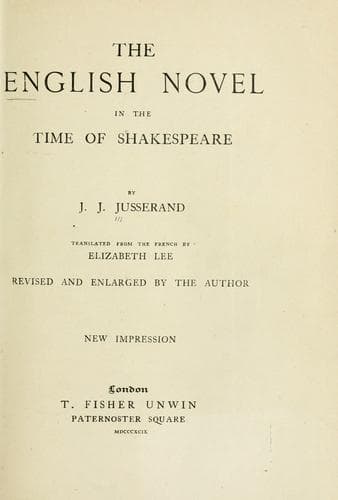
The English Novel in the Time of ShakespeareJusserand, J. J. (Jean Jules)
History
The English Novel in the Time of Shakespeare
Jusserand, J. J. (Jean Jules)
English fiction -- Early modern, 1500-1700 -- History and criticism
empires de la lune et du soleil," Fenelon's "Telemaque," "Gulliver's
Travels," Voltaire's tales, &c. More's use of Latin is to be the more
regretted since his romance exhibits infinite resources of spirit and
animation; of all his writings it is the one that best justifies his
great reputation for wit and enlightenment. His characters are living
men and their conversation undoubtedly resembles that which delighted
him in the society of his friend Erasmus.
The subject of the book is the quest for the best possible government.
More and his companions meet at Antwerp one of the fellow voyagers of
Amerigo Vespucci the famous godfather of America, and they question him
concerning the civilizations he has seen. "He likewise very willingly
tolde us of the same. But as for monsters, by cause they be no newes, of
them we were nothyng inquisitive. For nothyng is more easye to bee
founde, then bee barkynge Scyllaes, ravenyng Celenes, & Lestrigones
devourers of people, & suche lyke great, & incredible monsters. But to
find citisens ruled by good & holsome lawes, that is an exceding rare, &
harde thyng."[18] By good luck Amerigo's companion had discovered an
empire which presented this admirable quality: the island of Utopia, or
the country of "Nowhere." This country became immediately famous all
over Europe, so much so that Pantagruel would not look to any other
place for immigrants to people his newly conquered kingdom of Dispodie.
There he transported "Utopians to the number of 9,876,543,210 men," says
Rabelais, with his usual care for exact numbers, "without speaking of
women and little children." He did so to "refresh, people, and adorn the
said country otherwise badly enough inhabited and desert in many
places."[19] His acting in this manner was only natural, for, as is well
known, connections existed between his family and the Utopians, his own
mother Badebec, the wife of Gargantua, being "daughter to the king of
the Amaurotes in Utopia."[20]
A hundred years later, something of this want of confidence in the
future of English prose still lingered. Bacon, after having employed it
in his essays and treatises, was seized with anxiety and kept in his pay
secretaries with whose help he meant to translate all his works into
Latin, in order to assure himself of their permanence.
III.
Public-domain text, read in full here on John Shaqi.
Reviews
Reviews
No reviews yet
Be the first to share your thoughts on this work.
Join the Discussion
Join the discussion
Sign in to leave a comment or review.
Sign InorCreate an account