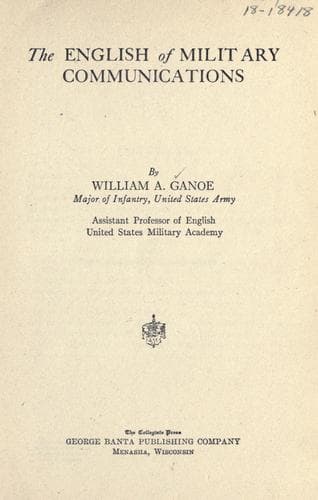
The English of military communications — John Shaqi
The English of military communicationsGanoe, William Addleman
History
The English of military communications
Ganoe, William Addleman
English language -- Rhetoric; Military orders; United States. Army -- Records and correspondence
5. Never use _he_, _it_, _this_, _him_, _her_, _their_, _them_,
_that_, _those_, _which_, _whose_, or the like, without looking at
them from every angle to make sure that they refer to a _single
word_. If they refer to a whole statement or to two or more possible
words, they are used wrongly. The addition of a noun will usually fix
the meaning. Suppose you were to receive a message with this sentence
in it:
The platoon leader assigned to one squad the wrong objective, and
it delayed the firing.
Grammatically, the objective delayed the firing. Logically, either
the act of the platoon leader or the squad delayed the firing. You
make out by re-reading the whole message that it must have been the
mistake of the platoon leader which delayed the firing. But in the
meantime you have lost three minutes, and the government has lost
that much efficiency.
_And this_ or _which_ in place of “_and it_” in the message would
have made the sense no clearer. But _and this error_, or _which
error_, makes the meaning unmistakable.
6. Never use a participle without inspecting it to see that it does
not dangle—that it refers to the subject of the sentence rightly.
Example:
“Looking over the crater, the periscope of the enemy was seen to
turn.”
What this sentence really says is that the periscope was looking
over the crater—a very possible happening. But all circumstances
connected with the idea, after a series of mental deductions on the
part of the reader, reveal that the writer had been looking over the
crater at the periscope. The commander who received this information
might have been led to believe that the periscope was situated in the
crater. At least he was delayed, if not misled.
7. Do not use _and_ except where necessary. Usually, when we connect
clauses with it, we do not mean _and_, but some more expressive word
such as _because_, _whereas_, _when_, etc.
8. Do not use any word which might not mean the same thing to any
probable recipients, or might not commonly be understood. For
instance, to a southerner _evening_ means something different from
its significance to a northerner, and to an Englishman _clever_ has
not the American meaning. Watch the words which have local standards.
AS TO PHRASES AND CLAUSES.
1. Do not allow a phrase or a clause to string out your expression
when one word might answer. Boil your communication to the clearest
minimum.
(a). We went back to headquarters with all possible speed. We
hurried to headquarters.
Here the specific verb _hurried_ does away with your phrase _with all
possible speed_.
(b). When we were present in the cantonment, the soldiers looked as
though they were quite hungry.
Our inspection of the cantonment revealed the soldiers to be hungry.
Here _our inspection_ does away with the clause _when we were
present_; and _to be hungry_ does away with _as though they were
quite hungry_.
Public-domain text, read in full here on John Shaqi.
Reviews
Reviews
No reviews yet
Be the first to share your thoughts on this work.
Join the Discussion
Join the discussion
Sign in to leave a comment or review.
Sign InorCreate an account