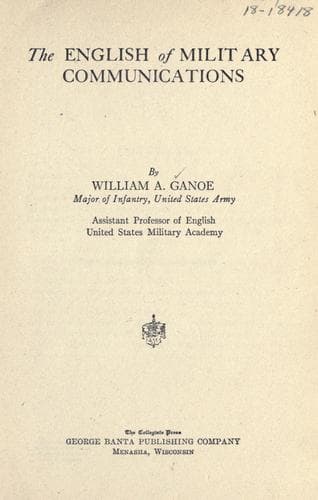
The English of military communicationsGanoe, William Addleman
History
The English of military communications
Ganoe, William Addleman
English language -- Rhetoric; Military orders; United States. Army -- Records and correspondence
This error of spreading words is common to ordinary writers and is
most tiring and time-wasting to readers.
2. Do not omit words from your phrases and clauses where there is a
chance for misunderstanding. Examples:
The detachment commander will be with the main body until 7 a. m.
and thereafter the advance guard.
What is really stated is that the advance guard will be with the main
body after 7 a. m.—an unintended statement. Make your grammar accord
absolutely with your meaning. Add the _with_ which belongs before
_the advance_, and notice how the sense is brought out. Again,
They order us to go to Brownsville and do impossible things.
In this sentence do they order us to do impossible things, or do they
themselves do impossible things?
Add the sign of the infinitive where it belongs before _do_. _And to
do impossible things_ reads unmistakably.
3. Do not use a participial phrase without first inspecting it to see
that it holds but one idea.
Having changed our position, the enemy was confused.
What this sentence really says is that the enemy, when he had changed
our position, was confused. This meaning is evidently not intended
from the very nature of the statement.
It is clearer and more accurate to use a finite form of the verb
instead of the participle; as,—
Because we changed our position we confused the enemy.
Or if you can condense with accuracy,
The change in our position confused the enemy.
AS TO SENTENCES.
1. Avoid long involved sentences. Even if they are grammatically
well constructed, they are liable to rhetorical error. The following
sentence because of its length violates unity:
“The organization of the German army is today well known to
American Army officers, and experience has shown that German
problems and solutions of a complex character changed in
translation to conform to American units are often more troublesome
for the student to understand than the original would be, as, on
account of the difference in the size of the units, it is often
necessary in reading such a translation to go back to the German
organization in order to explain a distribution of troops, which,
though simple for a German division, would be an awkward one for a
division organized after our own Field Service Regulations.”
The first thought given to the reader is that “the organization of
the German army is today well known to American Army officers.”
The last thought of the sentence is that the “explanation of a
distribution of troops would be an awkward one for a division
organized after our own Field Service Regulations.” The path from the
first thought to the second is long and winding. In fact the two do
not belong in the same sentence as the sense stands.
With a simple change we can make the whole easier to read:
Public-domain text, read in full here on John Shaqi.
Reviews
Reviews
No reviews yet
Be the first to share your thoughts on this work.
Join the Discussion
Join the discussion
Sign in to leave a comment or review.
Sign InorCreate an account