The English of military communications — John Shaqi
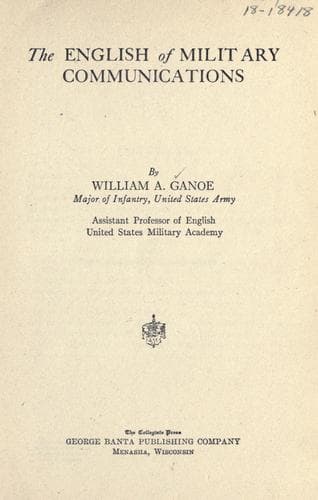
The English of military communicationsGanoe, William Addleman
History
The English of military communications
Ganoe, William Addleman
English language -- Rhetoric; Military orders; United States. Army -- Records and correspondence
The organization of the German army is today well known to American
Army officers. Their experience has shown that German problems and
solutions of a complex character changed in translation to conform
to American units are often more troublesome for the student to
understand than the original would be. On account of the difference
in the size of the units, it is often necessary in reading such
a translation to go back to the German organization in order to
explain a distribution of troops, which, though simple for a German
division, would be an awkward one for a division organized after
our own Field Service Regulations.
The reader has been allowed to take in a thought at a time instead of
three thoughts at once.
In spite of the injunction in our Field Service Regulations that
“short sentences are easily understood,” such long and involved
expressions as the above have abounded among military writers.
In war, this continuous motion in a single sentence has marred
undertakings; in peace, it has robbed efficiency. It has been an
incubus upon general orders, and even communications in the field.
CAUTION.—By short sentences we do not mean choppy sentences—sentences
unnecessarily short as,—
The battalion halted for the night. It ate supper. Then the
battalion relieved the outpost.
Here the reader has been stopped when he should have been kept going,
for there is in reality but one thought in the three separate
sentences. They should be combined into some such form as this,—
After the battalion had halted for the night and had eaten supper,
it relieved the outpost.
The proper relation of ideas is here expressed for the reader. He
knows that the relief of the outpost is the main consideration,
depending in point of time upon the halt and supper. And the whole
thought is not too big for him to take in as he reads.
The first error, illustrated by the sentence concerning German
organization, is a fault common to older writers. They have allowed
themselves to grow into the habit of adding qualifying phrases and
clauses to sentences already completed until their additions come to
swamp the originals. The second error, illustrated by the sentence
concerning the battalion relieving the outpost, is a fault common
to young writers. They have not yet formed the habit of relating in
their own minds the separate ideas of a complete thought.
The happy mean between these two indefinite extremes is the one we
wish to find—the sentence that gives speedy and accurate intelligence.
2. Do not use compound sentences containing _and_, save where they
cannot be avoided. Here is a common piece of slovenliness found in
such a construction.—
The wagon trains pulled out and the troops ate breakfast.
Any one of the following is more definite.
After the wagon trains pulled out the troops ate breakfast.
The wagon trains pulled out before the troops ate breakfast.
As the wagon trains pulled out the troops ate breakfast.
Public-domain text, read in full here on John Shaqi.
Reviews
Reviews
No reviews yet
Be the first to share your thoughts on this work.
Join the Discussion
Join the discussion
Sign in to leave a comment or review.
Sign InorCreate an account