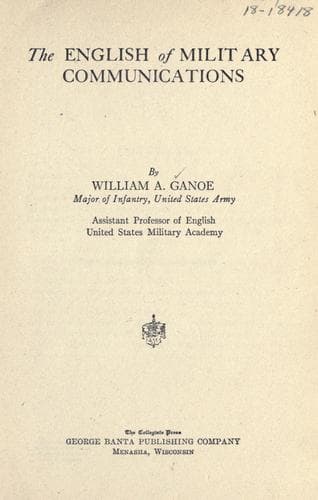
The English of military communicationsGanoe, William Addleman
History
The English of military communications
Ganoe, William Addleman
English language -- Rhetoric; Military orders; United States. Army -- Records and correspondence
The writer in the first instance was too lazy or stupid to think out
the specific meaning of _and_ for the reader.
Remember, also, that the use of _and_ to connect clauses leads us
into the treacherous “run-on sentences”—the sentence that flits from
subject to subject like an old gossip.
“They fell into the trap and so the commanding officer’s orders
were lost and they remained there twenty days and were finally
removed to a prison camp and there winter soon came on and finally
they were released and went home in the spring.”
The sentence, in addition to having too many ideas in it, has them
unrelated.
WHAT WE MUST DO
AS TO WORDS.
1. Every geographical name must be printed in capitals, thus,—
WEST POINT, MARNE RIVER, PARIS.
This rule does not mean that the names must be printed, merely, but
that every letter must be capitalized legibly.
If the place be not pronounced as it is spelled, it should appear
thus,—XENIA (Zē′-nĭ-ä), POUGHKEEPSIE (Pṓ-kĭp′-sĭ), CHIHUAHUA
(Chḗ-wä′-wä).
A road must be designated by enough points to make it unmistakable
along the entire course considered; thus:—
BIGLERVILLE—582—CENTER MILLS. (See map, A-8 and 7.) The 582 inserted
in this case keeps the course from being confused with the turn-off
toward GUERNSEY. If the course were intended to lie through GUERNSEY,
the road would appear thus,—
BIGLERVILLE—GUERNSEY—CENTER MILLS.
2. Use the words of one syllable preferably. You will find that the
longer words come to you more readily but are usually more hazy in
meaning. You will gain vigor and clearness by the cultivation of
Anglo-Saxon.
3. Do not connect two sentences by a comma; for example:—
The phrase does not imply motion, thus it would mean nothing to say
that the battery is advancing on the line Twins-Concrete Ford.
The error here is not so much one of punctuation as of sentence
idea. Somehow, the thought does not run smoothly. We find that two
separate thoughts without much relationship have been compressed into
a single sentence—into something which should be a complete whole,
and go from capital to period without break. Oftentimes, by showing
this relationship, we may bring the idea within bounds of a single
sentence; for example:—
Since the phrase does not imply motion, it would mean nothing to
say that the battery is advancing on the line, etc.
4. Watch the position of your adverbs. When you mean,—
We captured almost all the ammunition,
Do not say,—
We almost captured all the ammunition.
The first means that we captured at least a part of the ammunition;
the second means that we were close to success, but failed to capture
ammunition.
5. Use the words _head_ and _tail_ when speaking of a column of
troops. The head is the leading element and the tail is the other
end, no matter in which direction the column happens to be facing.
Public-domain text, read in full here on John Shaqi.
Reviews
Reviews
No reviews yet
Be the first to share your thoughts on this work.
Join the Discussion
Join the discussion
Sign in to leave a comment or review.
Sign InorCreate an account