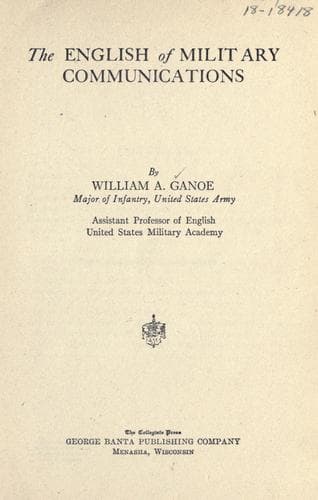
The English of military communicationsGanoe, William Addleman
History
The English of military communications
Ganoe, William Addleman
English language -- Rhetoric; Military orders; United States. Army -- Records and correspondence
Whether slang, profanity, or colloquialisms have cut into our
ordinary speech to such an extent as to keep us at a loss for the
apt word, or whether we have grown careless or slovenly in our
habits of expression, is a matter with which we are not concerned
here. We do know that we are continually hampered by our inability
to state absolutely our meaning. This lack of skill in composition
which besets us, we must overcome in our profession, for the sake
of the lives dependent upon our words. Napoleon sitting at his desk
scribbling off orders and messages as fast as his nimble fingers can
travel, his secretaries standing about him grasping each finished
piece from under his pen and sending it off immediately by courier
without revision or correction, is a dazzling picture for the
military leader to contemplate. In his writing, a commander capable
of carrying out single-handed all the phases and minor items of the
mightiest of campaigns could, no doubt, be precise and accurate
habitually. He _was_ a genius. Yet Napoleon had had long years of
practice in putting his will into words; for, we are told, he began
to compose orders and to think tactically and strategically at a
time of life when most of us have not even chosen our careers.
If, then, we can try our hand at transcribing our ideas in as
formative a period as possible in our military careers, we, too,
may attain a proficiency that will become a second nature with us.
At least, we may put behind us a great part of this uninteresting
but indispensable work of learning to control our language, before
we confront the more serious task of straightening out tactical and
strategical difficulties in the presence of the enemy.
Incidentally, while we are on our way in our progress in expression,
we may pick up much valuable military information. In our practice
with tactical language we must make use of certain facts which have
been found by experience appropriate to certain happenings connected
with officers’ and soldiers’ duties. We shall be in constant touch
with the workings of patrols, advance guards, outposts, and forces
in battle. Like so many reporters we shall be present at maneuvers
putting our notes into graphic and specific form.
Public-domain text, read in full here on John Shaqi.
Reviews
Reviews
No reviews yet
Be the first to share your thoughts on this work.
Join the Discussion
Join the discussion
Sign in to leave a comment or review.
Sign InorCreate an account