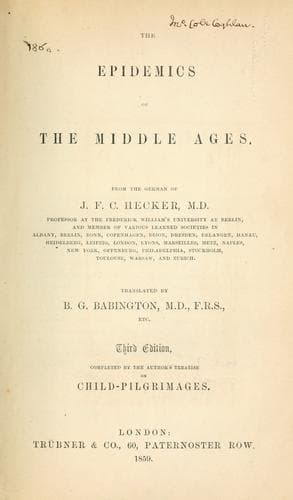
The Epidemics of the Middle AgesHecker, J. F. C. (Justus Friedrich Carl)
History
The Epidemics of the Middle Ages
Hecker, J. F. C. (Justus Friedrich Carl)
Black Death; Epidemics -- History; Hysteria, Epidemic
This account is nevertheless rendered credible by the ascertained fact,
that the palaces of princes are less accessible to contagious diseases
than the dwellings of the multitude; and that in places of importance,
the influx from those districts which have suffered least, soon repairs
even the heaviest losses. We must remember, also, that we do not gather
much from mere numbers without an intimate knowledge of the state of
society. We will, therefore, confine ourselves to exhibiting some of
the more credible accounts relative to European cities.
In Florence there died of the Black Plague 60,000[64]
In Venice 100,000[65]
In Marseilles, in one month 16,000[66]
In Siena 70,000[67]
In Paris 50,000[68]
In St. Denys 14,000[69]
In Avignon 60,000[70]
In Strasburg 16,000[71]
In Lübeck 9,000[72]
In Basle 14,000
In Erfurt, at least 16,000
In Weimar 5,000[73]
In Limburg 2,500[74]
In London, at least 100,000[75]
In Norwich 51,100[76]
To which may be added—
Franciscan Friars in Germany 124,434[77]
Minorites in Italy 30,000[78]
This short catalogue might, by a laborious and uncertain calculation,
deduced from other sources, be easily further multiplied, but would
still fail to give a true picture of the depopulation which took
place. Lübeck, at that time the Venice of the North, which could no
longer contain the multitudes that flocked to it, was thrown into
such consternation on the eruption of the plague, that the citizens
destroyed themselves as if in frenzy.
Merchants whose earnings and possessions were unbounded, coldly and
willingly renounced their earthly goods. They carried their treasures
to monasteries and churches, and laid them at the foot of the altar;
but gold had no charms for the monks, for it brought them death. They
shut their gates; yet, still it was cast to them over the convent
walls. People would brook no impediment to the last pious work to which
they were driven by despair. When the plague ceased, men thought they
were still wandering among the dead, so appalling was the livid aspect
of the survivors, in consequence of the anxiety they had undergone,
and the unavoidable infection of the air[79]. Many other cities
probably presented a similar appearance; and it is ascertained that
a great number of small country towns and villages which have been
estimated, and not too highly, at 200,000[80], were bereft of all their
inhabitants.
Public-domain text, read in full here on John Shaqi.
Reviews
Reviews
No reviews yet
Be the first to share your thoughts on this work.
Join the Discussion
Join the discussion
Sign in to leave a comment or review.
Sign InorCreate an account