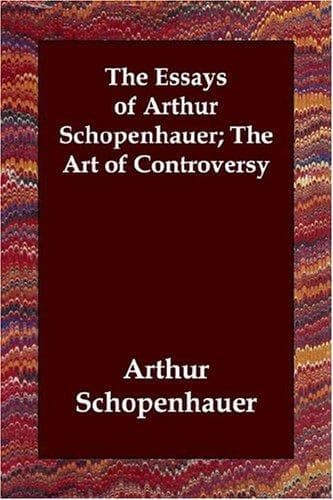
The Essays of Arthur Schopenhauer; the Art of ControversySchopenhauer, Arthur
Philosophy
The Essays of Arthur Schopenhauer; the Art of Controversy
Schopenhauer, Arthur
Debates and debating; Logic
But there are very many authorities who find respect with the mob, and
if you have none that is quite suitable, you can take one that appears
to be so; you may quote what some said in another sense or in other
circumstances. Authorities which your opponent fails to understand are
those of which he generally thinks the most. The unlearned entertain a
peculiar respect for a Greek or a Latin flourish. You may also, should
it be necessary, not only twist your authorities, but actually falsify
them, or quote something which you have invented entirely yourself. As
a rule, your opponent has no books at hand, and could not use them if
he had. The finest illustration of this is furnished by the French
_curé_, who, to avoid being compelled, like other citizens, to pave
the street in front of his house, quoted a saying which he described
as biblical: _paveant illi, ego non pavebo_. That was quite enough for
the municipal officers. A universal prejudice may also be used as an
authority; for most people think with Aristotle that that may be said
to exist which many believe. There is no opinion, however absurd,
which men will not readily embrace as soon as they can be brought to
the conviction that it is generally adopted. Example affects their
thought just as it affects their action. They are like sheep following
the bell-wether just as he leads them. They would sooner die than
think. It is very curious that the universality of an opinion should
have so much weight with people, as their own experience might tell
them that its acceptance is an entirely thoughtless and merely
imitative process. But it tells them nothing of the kind, because they
possess no self-knowledge whatever. It is only the elect Who Say with
Plato: [Greek: tois pollois polla dokei] which means that the public
has a good many bees in its bonnet, and that it would be a long
business to get at them.
But to speak seriously, the universality of an opinion is no proof,
nay, it is not even a probability, that the opinion is right. Those
who maintain that it is so must assume (1) that length of time
deprives a universal opinion of its demonstrative force, as otherwise
all the old errors which were once universally held to be true would
have to be recalled; for instance, the Ptolemaic system would have
to be restored, or Catholicism re-established in all Protestant
countries. They must assume (2) that distance of space has the same
effect; otherwise the respective universality of opinion among the
adherents of Buddhism, Christianity, and Islam will put them in a
difficulty.
When we come to look into the matter, so-called universal opinion is
the opinion of two or three persons; and we should be persuaded of
this if we could see the way in which it really arises.
Public-domain text, read in full here on John Shaqi.
Reviews
Reviews
No reviews yet
Be the first to share your thoughts on this work.
Join the Discussion
Join the discussion
Sign in to leave a comment or review.
Sign InorCreate an account