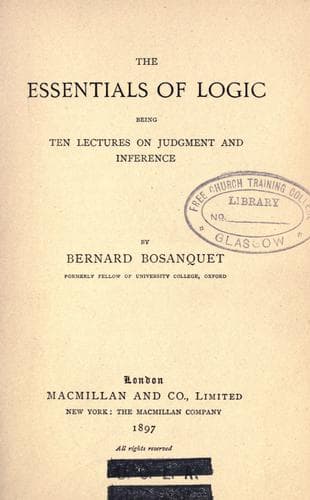
The Essentials of Logic, Being Ten Lectures on Judgment and InferenceBosanquet, Bernard
Philosophy
The Essentials of Logic, Being Ten Lectures on Judgment and Inference
Bosanquet, Bernard
Logic
Thus the separate worlds, in which we are all shut up, must be
considered as corresponding so far as they are objective, that is, so
far as they approach what we are ultimately obliged to think. I say
“corresponding,” because that is the term which expresses the relation
between systems which represent the same thing by the same rules,
but with different starting-points. Drawings in perspective of the
same building from different points of view are such corresponding
systems; the parts represented answer each to each, but the same part
is near or large in one drawing, and distant and small in another; not,
however, by chance, but as a definite consequence of the same laws.
Our separate worlds may be compared to such drawings: the things in
them are identified by their relations and functions, so that we can
understand each other, _i.e._ make identical references, though my
drawing be taken from the east, and yours from the west. The things do
not look quite the same in our different worlds; besides being taken
from different standpoints, both drawings are imperfect and incorrect.
But so {19} long as we can make out the correspondence, we have a basis
for co-operation and for discussion. Logic shows us the principles and
processes by which, under the given influences, these drawings are
constructed.
_Subjective Idealism_
8. If we merely hold to the doctrine of separate worlds, without
insisting upon their correspondence with each other and with reality,
we fall back into the position of subjective idealism, which is a
natural completion of common-sense theory, when, instead of turning
round to retrace its path, it runs deeper into the _cul-de-sac_. It
is a very obvious reflection, that each of us is shut up within his
own mind, and much easier to grasp than the reason for assuming a
real system which appears differently, though correspondingly, in the
centres of consciousness which are ourselves. We cannot get at anything
but in terms of consciousness; how can we justify the assumption that
our consciousness of a world of objects is rooted in reality, _e.g._,
that objects may rightly be treated as persisting and inter-acting
when our personal consciousness is withdrawn? And if we once doubt
this, then why should we assume that our ideas need be or tend to
be consistent with themselves and each other, as for the time they
apparently are?
Public-domain text, read in full here on John Shaqi.
Reviews
Reviews
No reviews yet
Be the first to share your thoughts on this work.
Join the Discussion
Join the discussion
Sign in to leave a comment or review.
Sign InorCreate an account