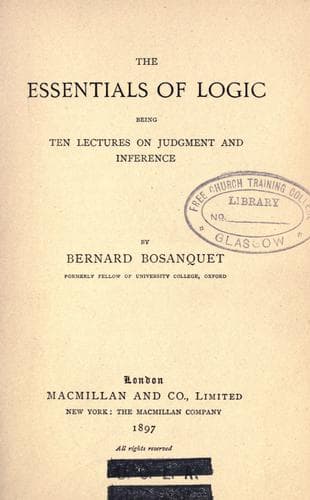
The Essentials of Logic, Being Ten Lectures on Judgment and InferenceBosanquet, Bernard
Philosophy
The Essentials of Logic, Being Ten Lectures on Judgment and Inference
Bosanquet, Bernard
Logic
We may take as an example our perception of things in space. How
much of what we see is given in present sense-perception? This is a
question to which there is no definite answer. We do not know what
the presentations of vision were like before we had learnt to see as
a fully conscious human being sees. We have no right to assume, that
after we have learned to see in this way the actual sense-presentation
remains the same as it was in a different stage of our visual
education. We can give no precise meaning in the way of a time-limit
to the _presentness_ of perception. But we know this much, that it
takes a long time and many kinds of experience to learn to see as an
educated human being sees, and that this acquired capacity is never at
a stand-still, but is always being extended or diminished according to
the vitality, growth, or atrophy of our apperceptive masses. There is
always a certain element of amplification or interpretation, which by
experience, or attentive introspection we can eliminate from the data,
apparently forced upon us by reality, although these data themselves
are modified through and through both by habitual interpretation,
and by the very defining attention which aims at eliminating all
amplification from them.
But yet the whole of sense-perception has a peculiar quality in being
_present_. Artificial though it is, it yet, relatively speaking,
contains an irreducible datum. It is distinguishable from everything
which is not present. It is pervaded by something which we cannot
reduce to {29} intellectual relation, though if we withdrew from it all
that is relation, the apparent datum would be gone.
Now Knowledge is the affirmation or judgment which identifies the
constructive interpretation of our present perception with the reality
which present perception forces upon us. This is clear enough to begin
with, but will have to be modified below to suit the more circuitous or
mediate types of Judgment.
I take two examples, one from sight and one from sound.
Public-domain text, read in full here on John Shaqi.
Reviews
Reviews
No reviews yet
Be the first to share your thoughts on this work.
Join the Discussion
Join the discussion
Sign in to leave a comment or review.
Sign InorCreate an account