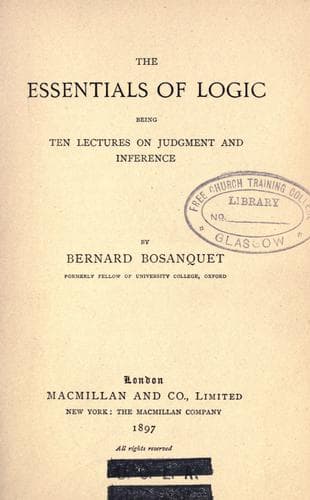
The Essentials of Logic, Being Ten Lectures on Judgment and Inference — John Shaqi
The Essentials of Logic, Being Ten Lectures on Judgment and InferenceBosanquet, Bernard
Philosophy
The Essentials of Logic, Being Ten Lectures on Judgment and Inference
Bosanquet, Bernard
Logic
5. To further illustrate the relation of what, in our permanent
judgment, is distinctly thought, what is dimly thought, and what is
implied, let us look for a moment at what we may call “the world
as will.” This is _not_ the doctrine of Schopenhauer in his work,
_The World as Will and Idea_, {38} although the two conceptions have
something in common. His is a metaphysical doctrine, in which he says
that the fundamental reality of the Universe must be conceived as
Will. We have nothing to do with that. We are speaking merely of what
the world is for us, and for us it is not only a system of reality
but a system of purposes. Our world of will is a permanent factor of
our waking consciousness, just as much as our world of knowledge.
Now our will is made up of a great number of purposes, more or less
connected together, just as our knowledge is made up of a great number
of provinces and regions more or less connected together. And just as
in our knowledge at any moment much is clear, much is dim, much is
implied, and the whole forms a continuous context, so it is with our
purposes.
When, for example, one stands looking at a picture, one’s immediate
conscious purpose is to study the picture. One also entertains dimly or
by force of habit the purpose to remain standing, which is a curious
though common instance of will. We do not attend to the purpose of
walking or standing, yet we only walk or stand (in normal conditions
of mind) as long as we will to do so. If we go to sleep or faint, we
shall fall down. Purpose, like judgment, is confined to the waking
consciousness.
But further; the purpose which one entertains in standing to look at a
picture is not really an isolated pin-point of will. It is uppermost
in the mind at the moment in which we carry it out, but it is only the
uppermost stratum, or perhaps rather the present point attained upon a
definite road, within an intricate formation or network of purposes,
which taken together constitute the world of will. The purpose of
looking {39} at a picture shades off into the more general purpose of
learning to take pleasure in what is good of its kind, which is again
set in a certain place within the conception of our life and the way
in which we desire to spend it, and our purposes throughout every
particular day are fitted into one another, and give a particular
setting and colour to each other, and to each particular day, and week,
and year.
Now less or more of all this may be clearly in the mind when we are
carrying out a particular momentary aim. But it is quite certain that
in a human life the particular momentary aim derives its significance
from this background of other purposes; and, if they were to fall away,
the distinct momentary purpose would change its character and become
quite a feeble and empty thing.
Public-domain text, read in full here on John Shaqi.
Reviews
Reviews
No reviews yet
Be the first to share your thoughts on this work.
Join the Discussion
Join the discussion
Sign in to leave a comment or review.
Sign InorCreate an account